
The Consortium for Holistic Steel Systems at the University of Wisconsin-Madison has released its first official pilot report, a comparative life cycle assessment of steel and oriented strand board roof deck systems for large commercial buildings.
The report, “A Comparative Life Cycle Assessment of Deck Choice for Large Commercial Roof Systems: Steel vs. Oriented Strand Board (OSB),” evaluates the cradle-to-grave environmental impacts of a conventional all-steel roof system and a hybrid wood-steel roof system.
The report is part of the consortium’s R3 framework, which evaluates building systems through three lenses: reliability, resiliency and renewability.
According to Hannah Blum, Ph.D., Alain H. Peyrot Associate Professor of Civil and Environmental Engineering at the University of Wisconsin-Madison, the findings show that both roof deck choices are environmentally comparable when uncertainty in the life cycle assessment data is considered.
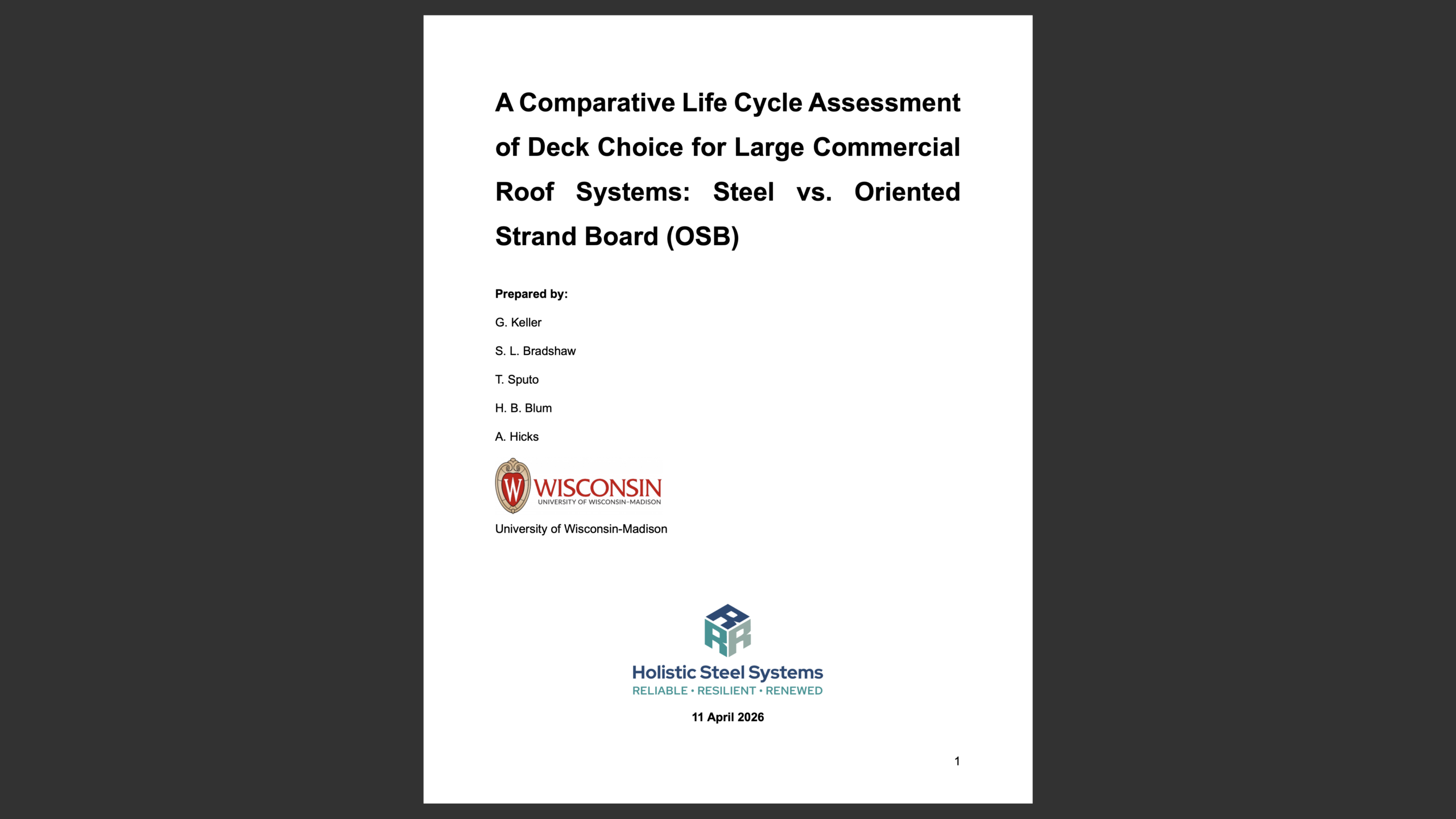
The R3 Consortium’s first pilot report compares the life cycle impacts of steel and OSB roof deck systems.
“This study reinforces the importance of evaluating entire building systems rather than focusing on a single material component,” said Don Allen, P.E., S.E., LEED AP, executive director of the Steel Framing Industry Association (SFIA), an R3 Consortium industry sponsor. “The research also highlights the role steel recycling can play in supporting a more circular built environment.”
Environmental Trade-Offs
The report found that neither the all-steel roof system nor the hybrid wood-steel roof system produced a clear environmental advantage across all impact categories.
The hybrid wood-steel system generally showed higher average global warming potential and eutrophication potential. According to Blum, those higher impacts were driven by end-of-life burdens associated with landfilling wood-based materials.
The all-steel roof system showed higher average acidification, smog formation, particulate matter and ecotoxicity impacts. Those impacts were associated with the manufacturing footprint of steel production.
However, researchers found that neither deck material was the primary contributor to overall environmental impacts. Composite roofing materials — specifically the roofing membrane, insulation and gypsum board — accounted for 43% to 94% of total impacts across nearly all categories in both roof designs.
The findings suggest that roof deck selection should be evaluated as part of a complete assembly rather than as an isolated material choice.
“For engineers, the report serves as a reminder that environmental performance is influenced by the interaction of all roof-system components,” said Patrick W. Ford, P.E., S.E., SFIA technical director.
Steel Recycling Benefits
Even so, the study found that the all-steel system showed significant environmental advantages at the end-of-life stage through steel recycling.
The report also noted the circular benefits of Electric Arc Furnace steel production, which relies heavily on secondary scrap feedstock.
Phase 2 Research Underway
The consortium is now advancing the second phase of the research, which will integrate resiliency factors into the use phase of the roof systems.
The research team is modeling more common severe loading scenarios, including wind, snow and thermal loading. The goal is to determine how in-service repairs following severe loading conditions affect the life cycle analysis and how the two roof systems compare.
The full report is available through the open-access MINDS@UW repository.