
Is automation alone enough to make an off-site production facility efficient? How can manufacturers reduce production bottlenecks? And what role does sustainability play in modern cold-formed steel (CFS) manufacturing?
Arkitech America, an SFIA member, recently explored these questions in a series of articles examining trends shaping CFS production, from automation and process control to scalability and material efficiency.
While the articles focus on the equipment used in the production of CFS members, they also reflect broader discussions occurring throughout the offsite construction and manufacturing steel framing products.
Image: Arkitech’s automated roll-forming technology supports cold-formed steel framing production at Arize Prefab.
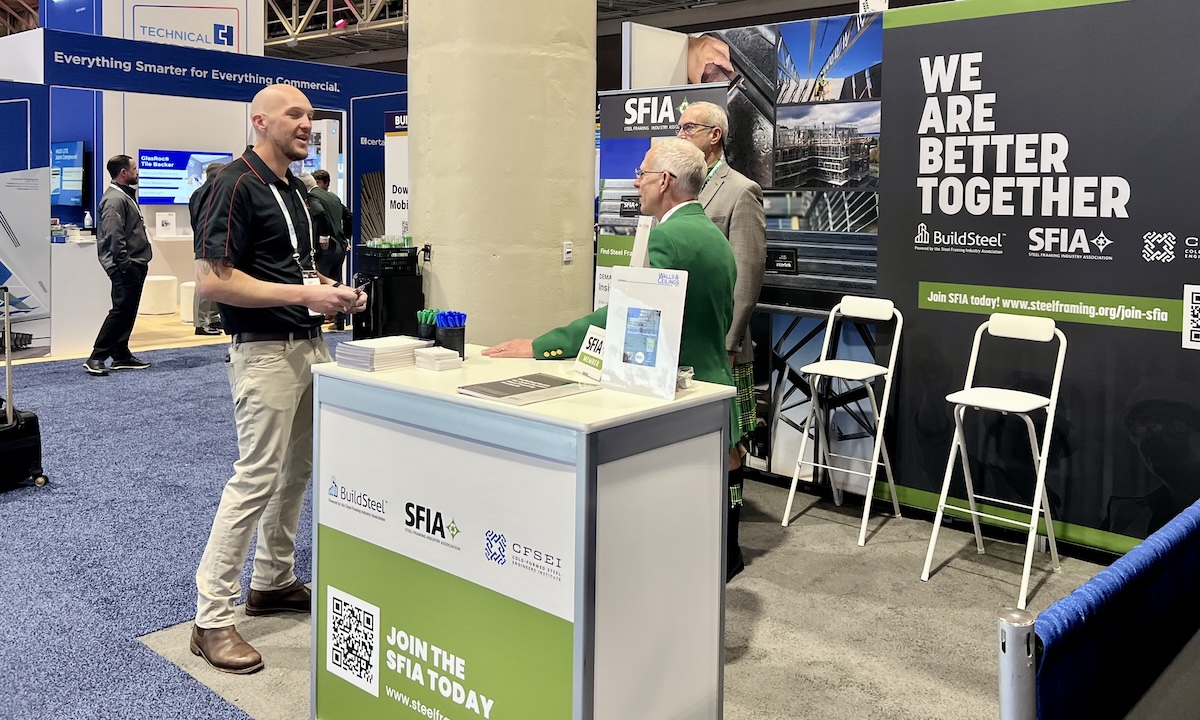
Ricky Wimberly of Arkitech America, an SFIA member, chatted with Don Allen, SFIA executive director, and Pat Ford, SFIA technical director, during BUILD26: AWCI’s Convention + Expo in New Orleans.
Looking Beyond Production Speed
According to Arkitech, manufacturers are increasingly looking beyond production speed as the primary measure of performance. Instead, companies are placing greater emphasis on consistency, repeatability and the ability to scale operations without sacrificing quality.
In its article, “Why Automation Alone Is Not Enough for Cold-Formed Steel Framers,” Arkitech argues that automation, while important, is only one component of a successful production system. Machine accuracy, process stability and software integration are equally important factors in controlling production errors and maintaining dimensional consistency, the article notes.
The article suggests that automated equipment must operate within a coordinated manufacturing system to achieve reliable results.
“Automation improves speed and repeatability, but dimensional accuracy depends on mechanical precision, calibration, and process control,” Arkitech says.
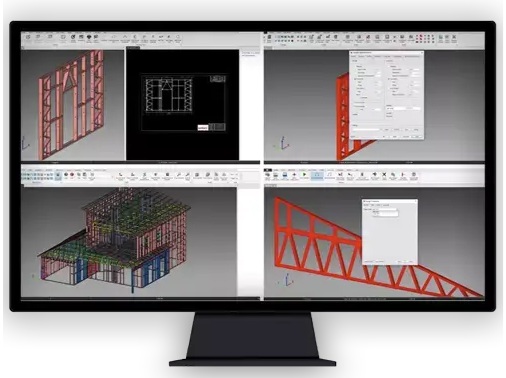
Arkitech software supports the design and detailing of cold-formed steel framing systems from building plans through fabrication-ready outputs.
Reducing Bottlenecks and Production Variability
A second article, “How High-Efficiency Light Gauge Steel Framers Eliminate Production Variability,” focuses on reducing bottlenecks and variability in cold-formed steel framing manufacturing operations.
According to Arkitech, manufacturers are increasingly prioritizing predictable output and stable production processes, particularly as modular and prefabricated construction methods become more common in the construction industry.
The company states that production variability can arise from manual adjustments, operator-dependent processes and inconsistent machine performance. To address those challenges, manufacturers are adopting systems that automate key production functions and maintain consistent operating conditions over extended production runs.
Arkitech contends that reducing variability can help manufacturers minimize rework, improve production planning and maintain delivery schedules.
“Eliminating production variability is not a result of isolated improvements. It requires a system-level approach where mechanical stability, automation, and data-driven control work together,” the article says.
The article also notes that scalability has become an important consideration for many manufacturers. As production volumes increase, companies seek ways to expand capacity while maintaining quality standards and workflow efficiency. According to Arkitech, this requires production systems that can support multiple shifts, additional production lines and varying profile types without significant disruption to existing operations.
Beyond Energy Consumption and the Environment
In a third article, “A New Era in Manufacturing Begins in 2026 with Sustainable Light Gauge Steel Framers,” Arkitech discusses sustainability as an increasingly important factor in manufacturing decision-making. Many cold-formed steel manufacturers are seeking ways to increase output while reducing material waste, energy consumption and resource use.
The article describes a shift toward CFS manufacturing strategies that combine digital workflows, automated production and resource efficiency.
“Instead of isolated processes, manufacturers benefit from a fully orchestrated system where design, forming, adjustment and quality monitoring communicate seamlessly,” Arkitech says.
Arkitech contends that sustainability in the cold-formed steel sector extends beyond energy consumption and environmental goals. Manufacturers are increasingly focused on reducing steel scrap by improving cut accuracy. They want to produce framing members right the first time to avoid waste, the company says.
Takeaway for CFS Product Manufacturing
Taken together, the three articles point to a broader trend in industrialized construction and CFS manufacturing. Machine speed is no longer the only measure of manufacturing performance. Steel-framing product manufacturers are also evaluating production systems based on quality, scalability and their ability to reduce waste.
Consistent cold-formed steel (CFS) production relies on stable processes, automated systems and repeatable manufacturing controls.
About Arkitech
Arkitech America develops roll-forming equipment, software and manufacturing systems for the cold-formed steel framing industry. The company serves manufacturers producing steel framing components for panelized, modular and conventional construction projects. Arkitech America is a member of the Steel Framing Industry Association (SFIA).
Additional Resources
- Cold-Formed Steel (CFS) Framing 101: A Practical Guide for Designers, Builders and Owners
- CFS 101 In Practice: Real-World Examples of Project Teams Using Cold-Formed Steel
- SFIA’s Steel Framing Learning Portal Has Metal Framing Education (24/7/365)