
Cold-formed steel (CFS) framing is showing up in an unexpected place — contemporary art.
In Seoul, artist Lotus L. Kang is using exposed steel joists from Super Stud Building Products as a central element in her work Chora Chora. It’s part of the Chora exhibition on view through May 10 at Kukje Gallery, located in the Samcheong-dong area of Jongno-gu, a central cultural district in Seoul, South Korea.
Super Stud is a member of the Steel Framing Industry Association (SFIA). Kang is a Canadian-born, New York–based contemporary artist recognized for immersive, materially responsive installations that merge sculpture, photography and architecture.
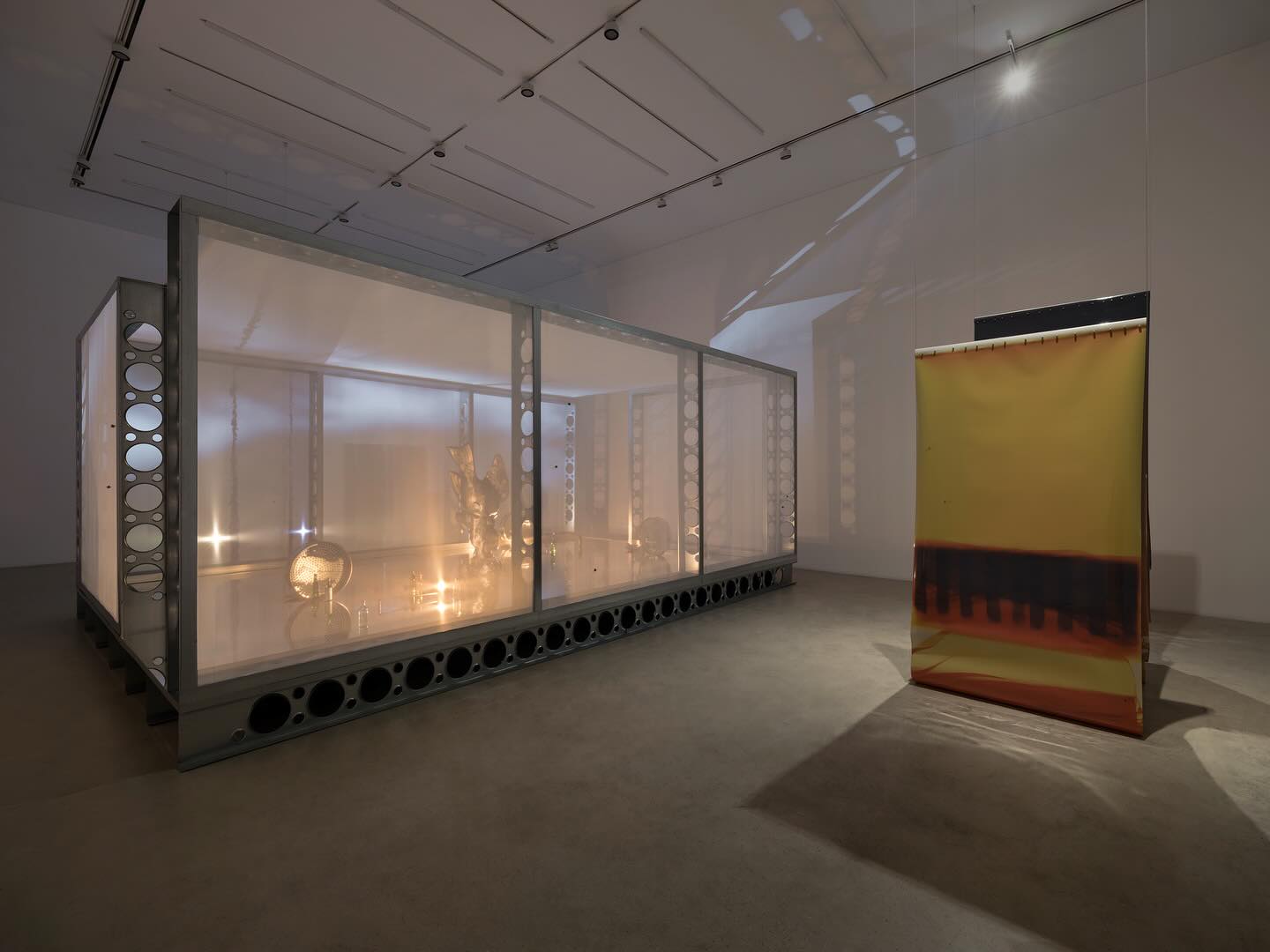
Artist Lotus L. Kang chose a cold-formed steel (CFS) joist with a patented hole pattern from SFIA member Super Stud Building Products for Chora Chora (at left).
Chora Exhibition at Kukje Gallery
Chora Chora features Super Stud’s cold-formed steel (CFS) joists, known for their distinctive large, round web openings. The patented hole pattern, originally developed during SFIA Executive Director Don Allen’s tenure at Super Stud, has become a recognizable design feature. When left exposed, the joist has strong visual appeal.
In Kang’s work, the joists form a courtyard-like structure layered with fabric and projected imagery. The installation explores space, memory and the idea of “in-between” conditions — where forms exist between solid and void. The open geometry of the steel framing reinforces that concept, allowing light and imagery to pass through the structure.
“Forms emerge from states that are neither fully solid nor fully void, but suspended in between,” Lotus L. Kang writes in an Instagram post announcing the exhibition.
The title draws from the concept of “chora” articulated by the Bulgarian-French philosopher, Julia Kristeva, which describes a primordial space prior to fixed meaning or form. Likened to a mother’s womb, “chora suggests a generative field — receptive, rhythmic, and continuously in flux,” Kang writes.

Artist Lotus L. Kang
An Aesthetically Pleasing Steel Stud
Super Stud personnel — Lori Ann Tardif, Malini Ramsamujh, Giancarlo Sanchez, Matt Bell and Brittany Morais — supported the project. They collaborated with the artist and project team to supply and adapt the joists for the installation. The system’s precision and repeatable geometry made it well-suited for the sculptural application.
The project reflects a broader trend: architects and artists increasingly specify exposed CFS components for both structural performance and aesthetics. The clean lines, consistent geometry and engineered openings offer flexibility beyond traditional building applications.
For SFIA, the installation underscores how steel framing continues to expand into new use cases — from high-performance buildings to creative expression.
While serving as marketing and technical services director at Super Stud, Susanne Allen worked on earlier projects with Ms. Kang using the same joist design. Now SFIA’s manager of advertising, she said the joists have appeared in a range of exposed applications because of their visual appeal.
“The hole pattern design is aesthetically pleasing, which is why the joist has been used in so many places where it’s left exposed,” she says.
In Seoul, that combination is on full display — with steel framing not just supporting the space, but helping define it.
Additional Resources
- Eastern Metal Building Products Acquires Super Stud Building Products
- Conversion to Steel: ADTEK Wins SFIA Award for Wagner College Locker Rooms
- SFIA 2026 Annual Meeting Features Newly Approved Certification Program, Industry Awards and More