
Developers have relied on cold-formed steel (CFS) framing for decades for their residential, commercial and institutional projects. Now, they’re choosing CFS framing for data center projects — to accelerate construction schedules and ensure consistent results.
In the article “How Cold-Formed Steel Streamlines Data Center Construction,” Steel Framing Industry Association (SFIA) member FRAMECAD highlights CFS for its strength-to-weight ratio, noncombustibility, dimensional accuracy and fast installation — key features that meet data center needs.
“For developers, these attributes translate into shorter construction programs, improved cost certainty and reduced risk,” says Nader Elhajj, FRAMECAD engineering director in sales. “For manufacturers and panelizers, cold-formed steel enables repeatable, scalable production that supports the aggressive timelines typical of data center projects.”
Graphics provided by FRAMECAD.
Data Center Market’s Unprecedented Expansion
The data center market is expanding rapidly as cloud computing, artificial intelligence and digital services drive global demand.
Developers are investing heavily in new facilities, with global capital expenditures projected to reach nearly $7 trillion by 2030. The United States leads this growth, with more than 5,400 data centers and continued expansion in key regions such as Virginia, Texas and California.
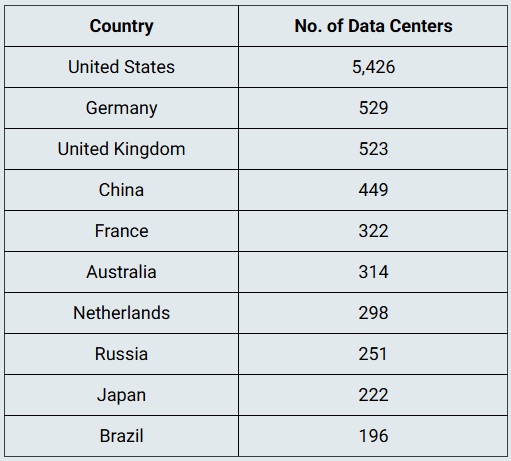
The top 10 countries with the highest number of data centers.
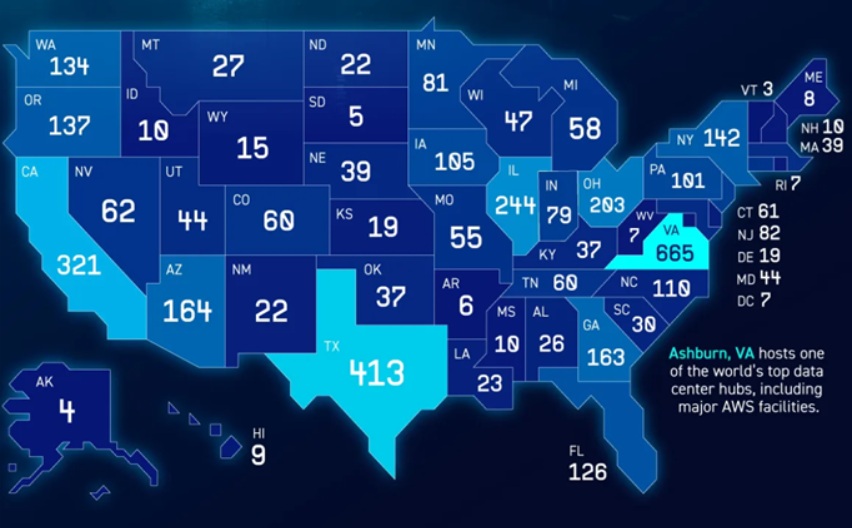
The distribution of data centers in the U.S. in 2025.
Projects range from small enterprise facilities to hyperscale campuses exceeding one million square-feet, pushing developers to prioritize scalable, efficient construction solutions that can meet aggressive timelines and performance expectations.
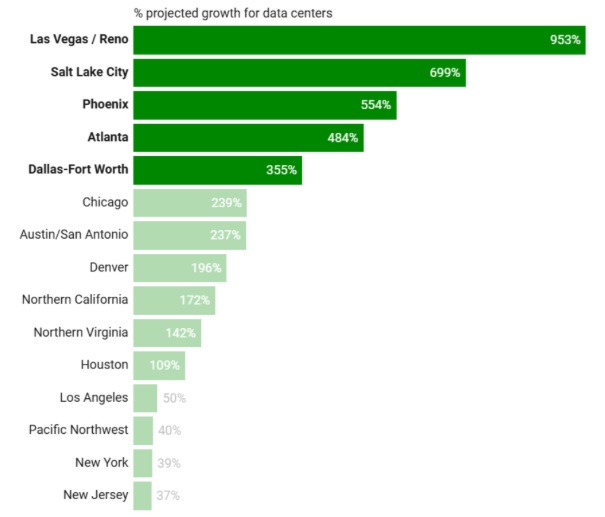
The fastest-growing data center hubs in the U.S. through 2030.
3 Reasons Developers Choose CFS for Data Centers
Developers are selecting cold-formed steel (CFS) to meet the speed, scale and performance demands of data center construction. Three key advantages explain why CFS continues to gain traction across these projects:
1. Repeatable Design and Scalable Framing
CFS supports repeatable design strategies that define data center construction. Teams rely on proven templates, and CFS framing systems adapt across projects and locations.
“CFS is widely used for exterior façades and interior wall systems, both load-bearing and non-load-bearing,” says Elhajj.
Internally, data centers require tall, high-capacity walls to support dense equipment layouts.
“Wall heights are increasing, with typical ranges between 29 and 36 feet and some facilities incorporating three-story-high wall systems,” says Elhajj. “CFS studs can be engineered with varying steel thicknesses to achieve the required heights and load capacities while remaining lightweight and easy to install.”
This flexibility allows developers to scale projects without adding complexity.
“We typically run six-inch lines where engineering allows,” says David Huff, senior project manager of C.J. Coakley, a Virginia-based contractor and SFIA member. “When height and load requirements demand it, we’ll introduce wider flanges or specialty studs to meet the structural needs without compromising efficiency.”
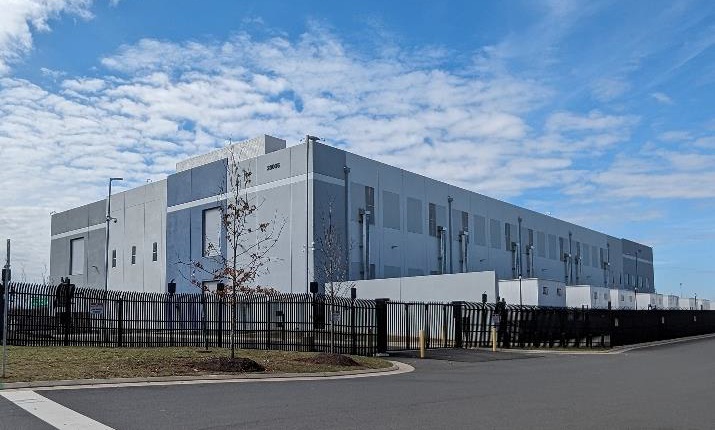
Wall heights are increasing in data centers, typically ranging from 29 to 36 feet, with some facilities incorporating three-story-high wall systems.
2. Offsite Manufacturing Drives Speed and Precision
Manufacturers produce CFS panels in controlled environments using automated roll-forming systems. This process ensures consistent quality and tight tolerances at scale.
“Rather than relying on onsite labor, teams engineer framing systems upfront to support efficient installation, with interfaces to concrete or structural steel resolved early in the design phase,” says Elhajj. “This reduces on-site complexity and enables faster, more predictable construction.”
Manufacturers deliver prefabricated components tailored to project requirements, which reduces installation errors.
“Schedules in the data center sector are particularly unforgiving,” says Elhajj. “Large facilities are often delivered in eight to nine months, with smaller projects completed in as little as four to five months, and substantial liquidated damages applied for delays.”
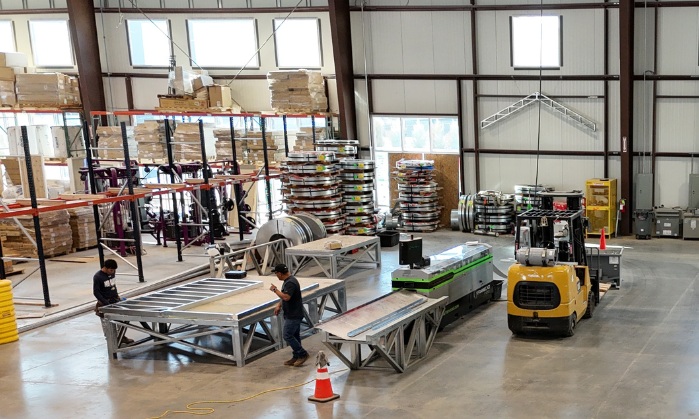
Manufacturers produce cold-formed steel (CFS) panels in controlled environments for data centers, using automated roll-forming systems to ensure consistent quality, tight tolerances and faster, more predictable construction. Photo Credit: FRAMECAD
3. Predictable Construction Through Integrated Design and Digital Tools
Project teams improve constructability by resolving design coordination early in the process.
Teams integrate framing with concrete and structural systems before construction begins, reducing field conflicts and delays.
Integrated engineering and detailing tools, such as FRAMECAD Steelwise, support design and compliance. The software enables efficient, code-compliant design to International Building Code requirements and produces complete structural documentation for permitting and approvals.
By streamlining engineering and documentation, FRAMECAD Steelwise reduces design costs and accelerates project start-ups – a key advantage in a highly competitive market.
Developers gain predictable schedules, lower risk and reduced waste. At the same time, CFS provides a noncombustible, durable solution that meets strict fire safety and resilience requirements.
The Steel Framing Advantage
Cold-formed steel (CFS) leads the way as the preferred framing material for prefabricated structures for multiple reasons. CFS is:
- A pre-engineered material that can be manufactured to exact lengths
- Dimensionally stable and does not expand or contract with changes in moisture content
- Lightweight compared to wood and concrete
- Resilient and will not warp, split, crack or creep when exposed to the elements
- Sustainable and 100% recyclable
- Durable and has a high tensile strength
- Non-combustible and is a safeguard against fire accidents
CFS Positions Data Centers for Future Growth
Cold-formed steel continues to prove its value as developers scale data center construction to meet rising demand. Its combination of speed, precision and performance helps teams deliver projects faster with greater confidence. As digital infrastructure expands, CFS positions teams to build efficiently while meeting evolving performance expectations.
Read the full article from FRAMECAD.

About FRAMECAD
FRAMECAD is an advanced, end-to-end design and build system enabling the rapid construction of quality buildings for businesses, governments and communities worldwide. FRAMECAD offers all the design expertise, intelligent software, steel framing manufacturing solutions, building products and support needed to produce rapid, durable, cost-effective quality buildings. For more information, visit framecad.com
Additional Resources
- 5 Reasons Developers Specify Steel for Mid-Rise Projects, According to FRAMECAD
- FRAMECAD Posts Beginners Guide to Steel Frame Manufacturing
- FRAMECAD Explains Shift from Traditional Design to DfMA with Cold-Formed Steel Framing