
Cold-formed steel (CFS) framing delivers more than performance — it offers real insurance savings for today’s construction projects. Steel framing reduces fire, weather and long-term risk, factors insurers directly consider when setting rates. As insurers recognize these benefits, builders gain access to lower premiums and more cost-effective coverage, an article from SFIA member Scottsdale Construction Systems says.
“Traditional wood construction increases the potential for fire, pests and rot, driving up rates,” says the Scottsdale article, “Extra Insurance Savings And Premiums Delivered With Steel Framing.” “By contrast, steel framing material is noncombustible, does not warp or rot, and resists mold and termites. When you build with cold-formed steel, you eliminate many of the risks that trigger higher claims.”
Images provided by Scottsdale Construction Systems
Risk Starts at the Frame
Builders’ risk insurance reflects exposure during the framing phase, when structural systems remain unfinished and fire protection systems are not yet active. As a result, framing material selection directly influences builders’ risk insurance underwriting and premium levels.
“During the construction phase, fire is one of the biggest threats to a project,” the Scottsdale article explains. “Wood structures remain vulnerable until they are completed and protected by active fire suppression systems.”
- Major losses on wood-framed projects require insurers to recalibrate construction risk assumptions
- Recalibrations often increase builders’ risk premiums for similar framing systems within the same geographic market
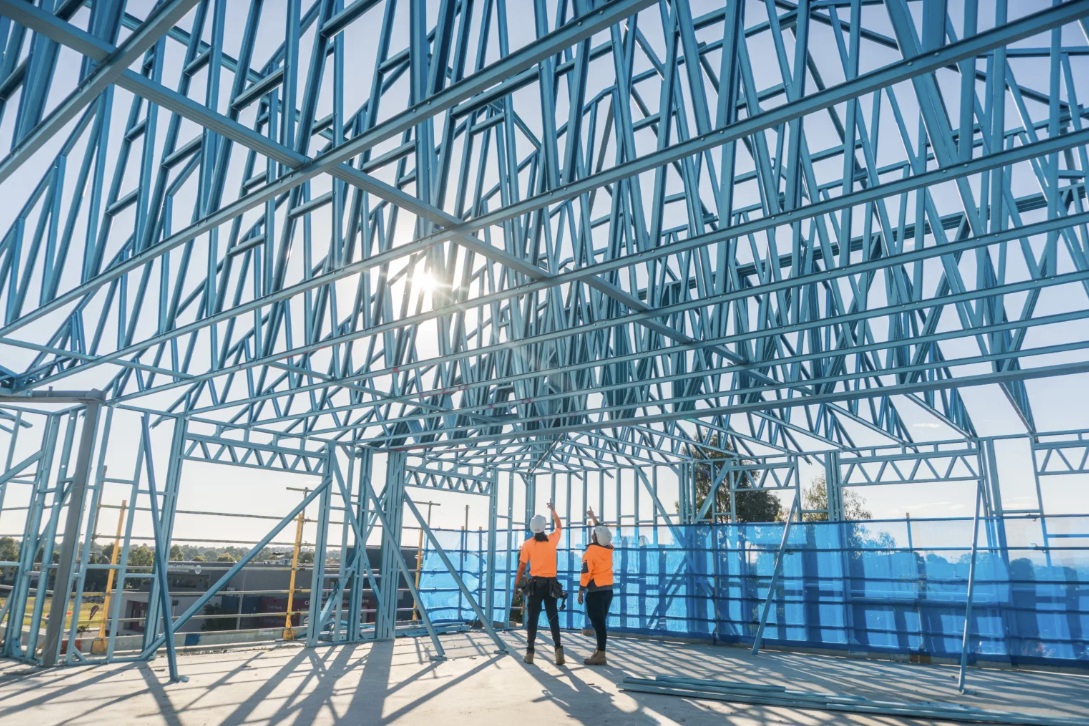
From an underwriting standpoint, cold-formed steel’s (CFS) noncombustible nature and ability to maintain structural integrity during fire exposure reduces fire growth risk and lowers the likelihood of total loss during construction.
Steel framing alters that risk profile. Cold-formed steel is noncombustible and does not contribute to fire growth. The material also maintains structural integrity during exposure, reducing the probability of total loss during construction.
From an underwriting standpoint, these characteristics reduce both loss severity and uncertainty. Insurers increasingly account for that difference when pricing builders’ risk insurance policies, Scottsdale says.
Surge in Fires: The Case for Steel Framing
Download this free article brief exploring the rise of fires in mid-rise wood construction across the U.S., highlighting incidents in California and Texas. The report outlines the key advantages of steel framing as a noncombustible alternative to significantly reduce fire hazards.

Performance That Insurers Track
“The benefits extend beyond the construction phase,” Scottsdale says. “Once occupied, buildings constructed with steel framing qualify for long-term insurance savings.”
That means buildings framed with CFS often qualify for lower long-term insurance premiums. Insurers evaluate durability, loss severity and performance over a structure’s full service life.
Furthermore, steel-framed buildings demonstrate more predictable behavior under extreme loading conditions that drive insurance claims. Fire resistance, wind performance and seismic response all reduce the probability of catastrophic loss.
Steel framing also reduces deterioration-related risk. Unlike organic materials, steel does not rot or support mold growth. That durability lowers the likelihood of maintenance-related claims over time.
In disaster-prone regions, these performance advantages help stabilize insurance availability. Resilient steel-framed construction supports long-term insurability as climate-driven risks continue to reshape insurance markets, Scottsdale says.
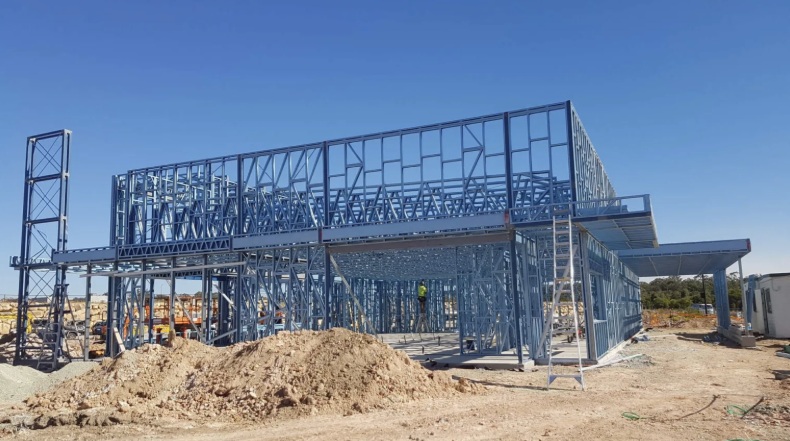
Buildings framed with cold-formed steel often qualify for lower long-term insurance premiums because insurers prioritize durability, reduced loss severity and reliable performance over a structure’s full service life.
Underwriting Confidence, Financial Stability
From an underwriting perspective, improved structural performance translates into reduced loss exposure. Insurers account for material behavior when assessing replacement risk, business interruption potential and long-term claims history.
These factors support greater cost certainty for owners and developers. Multifamily and commercial portfolios benefit from more stable premiums, improving operating forecasts and long-term asset valuation.
“When insurers recognize that a building framed with steel framing material is less likely to incur catastrophic loss, they respond with lower insurance premiums,” the Scottsdale article explains.
As insurers place greater emphasis on resilience and predictability, steel framing strengthens both risk profiles and financial outcomes.
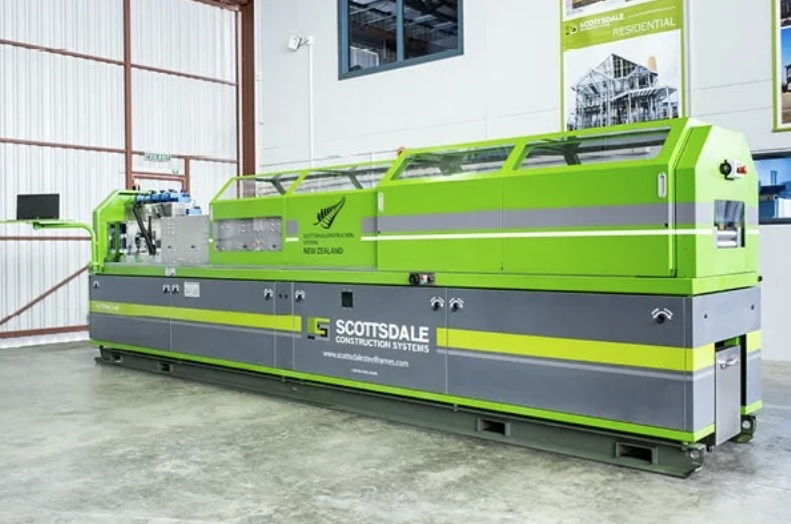
Modern steel framing machines, such as the Scotpanel 8140 roll-forming machine pictured above, improve construction quality and insurance outcomes by delivering precise, consistent components that reduce variability and ensure uniform performance across complete structural systems.
Precision Manufacturing Changes the Math
Modern machines that produce steel studs, joists and other member types strengthen construction quality — and insurance outcomes — by delivering consistent tolerances and engineered accuracy. These systems fabricate components that align precisely with design intent, reducing variability during assembly.
Steel framing machines support complete structural systems, including wall panels, floors and roof assemblies. Builders achieve uniform quality across the entire building envelope rather than relying on field adjustments.
“Buildings that are fabricated and assembled with exacting accuracy have fewer risks of structural errors or failures,” says the Scottsdale article. “When you build with cold-formed steel, you’re creating an envelope that insurers recognize as resilient, noncombustible and durable.”
Automation improves jobsite efficiency and safety. Pre-engineered components reduce field cutting and rework. Faster, more controlled assembly lowers construction-phase exposure.
“From start to finish, the advanced automation behind steel framing machines reinforces a safety and performance profile that leads to consistently lower insurance premiums,” Scottsdale says.
Read the full Scottsdale Construction Systems article.

About Scottsdale Construction Systems
Scottsdale Construction Systems is a global leader in cold-formed steel framing technology, providing advanced roll forming machinery and software solutions for efficient, precision-built structures. With over 25 years of innovation, Scottsdale empowers builders to deliver smarter, faster, and more sustainable construction. For more information, visit scottsdalesteelframes.com.
Additional Resources
- Scottsdale’s Cold-Formed Steel Roll Forming Tech Drives Next-Gen Modular Construction in the UAE
- Scottsdale Showcases Steel-Framed Barndominium for Veterans Live at METALCON 2025
- Update: Insurance Costs Are Re-Shaping Construction Choices — And the Data Speaks for Itself