
Falls Church, Virginia, November 21, 2025 — Cold-formed steel (CFS) framing has long offered designers options for creating chases, increasing acoustical performance and meeting fire-resistance requirements. A new Steel Framing Industry Association (SFIA) Technical Bulletin, Vol. 2, No. 4, “Cold-Formed Steel Chase Walls,” clarifies how to design and specify cold-formed steel chase walls. The bulletin discusses the structural, fire, bracing and acoustical considerations unique to different configurations.
“Thanks to this Technical Bulletin, designers and contractors will see that not every wall labeled a ‘chase wall’ actually meets the definition,” says Don Allen, SFIA executive director.
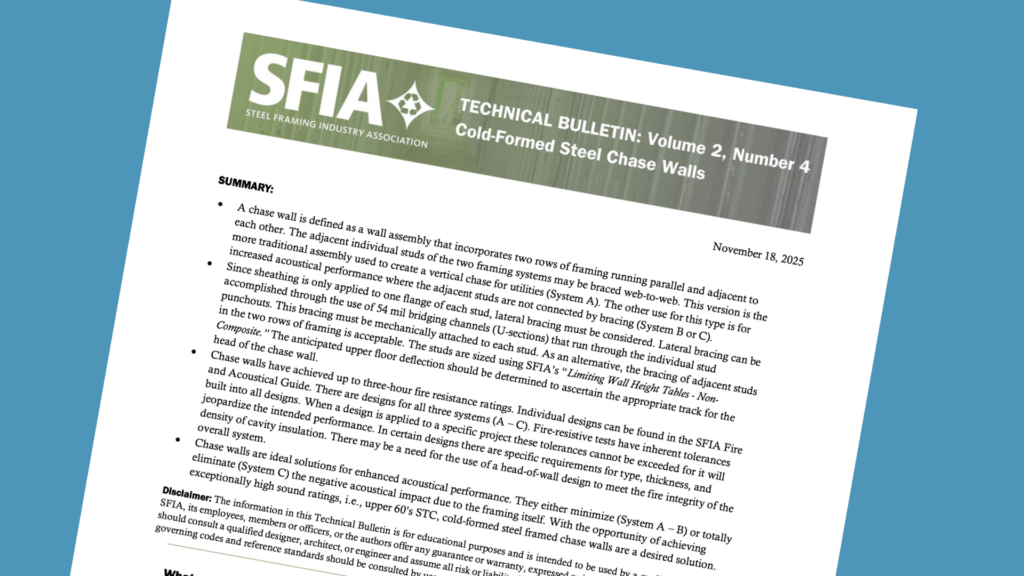
SFIA’s Tech Bulletin Vol. 2, No. 4, “Cold-Formed Steel Chase Walls,” defines cold-formed steel (CFS) chase walls and shows how they can enhance performance.
“Cold-Formed Steel Chase Walls”
Chase Walls Defined
A chase wall uses two rows of framing that run parallel and adjacent to each other. Builders historically used chase walls to create vertical pathways for pipes, ducts and wiring. Today, chase walls are also valued for their acoustical performance. The space between the rows creates a “chase.” Designers may connect adjacent studs. However, unconnected studs can improve sound isolation.
SFIA Tech Bulletin Vol. 2, No. 4 identifies three primary configurations of CFS chase walls:
System A – Traditional Braced
System A uses adjacent studs tied together with either gypsum board or cold-formed steel track gussets, spaced vertically at a maximum of 48 inches. This configuration is the basis for UL Design U420 and can provide one- or two-hour fire ratings. With gusset bracing, System A increases overall stiffness and may allow shallower studs while providing a small chase space.
System B – Unbraced Double-Row Studs
System B maintains a 1-inch minimum separation between rows, but the studs remain unconnected. This configuration is used mainly for its acoustical benefit rather than to create utility space. It corresponds to UL Design V463 Configuration C. Because there is no bracing between studs, lateral bracing within each row becomes necessary, typically using 54 mil U-section channels through the stud punchouts.
System C – Staggered Studs
System C places studs in staggered positions and eliminates stud-to-stud contact. This system corresponds to UL Design V469, a system that maximizes decoupling. This design can achieve very high acoustical performance.
What This Means for Designers and Contractors
Cold-formed steel (CFS) chase walls give designers and contractors a versatile way to meet fire, sound and structural requirements without adding complexity. Steel-framed chase walls provide utility. Some deliver strong acoustical performance — especially when staggered studs eliminate direct contact. Understanding the required bracing, wall height limits and UL designs help teams to deliver assemblies that perform as intended.
Structural, Fire and Acoustical Performance
Structural
The bulletin highlights several factors that influence how cold-formed steel chase walls are designed, including bracing, allowable heights and how to select the right stud depth and spacing. It also notes when movement at the top of the wall must be addressed. A sample calculation in the appendix shows how design choices can significantly affect the height a chase wall can achieve.
Fire
Chase walls can be designed to meet a range of fire-resistance ratings. SFIA Tech Bulletin Vol. 2, No. 4 explains which variables may be adjusted from tested assemblies, when insulation is required and how listed designs guide the overall fire performance of Systems A, B and C.
Sound
Chase walls can deliver strong sound performance. The bulletin outlines the factors that contribute to acoustical results — including separation between framing rows and how different system configurations affect STC ratings.
“Cold-Formed Steel Chase Walls”
About SFIA
The Steel Framing Industry Association (SFIA), a unique organization representing steel mills, coil coaters, stud and connector manufacturers, component fabricators, Cold-Formed Steel Engineers Institute (CFSEI) members, suppliers/distributors, contractors and others, provides members with exclusive access to technical cold-formed steel (CFS) framing services, including CFS certification, environmental product declarations, market data and analysis, technical design guides, specification review services, architectural services, the Steel Framing Learning Portal , the SFIA Awards and more. SFIA is an accredited ANSI Standards Development Organization. Follow SFIA on LinkedIn, Facebook, Instagram and X.

Additional Resources
- SFIA Clarifies Use of Steel Posts Within Cold-Formed Steel Wall Cavities
- FAQ: Where and How Do You Install Cold-Formed Steel (CFS) Resilient Channels?
- FAQ: What Are Resilient Channels, and What Is Their Purpose?
- Designers: Update to SFIA’s 2024 Tech Guide for the Latest CFS Load and Span Tables