
There are growing insurance advantages of cold-formed steel (CFS). In some cases, those advantages are big enough to change a pro forma.
When a Midwest hotel developer received updated builder’s risk pricing on a new six-story project framed in CFS, they didn’t believe the number.
“They were like, ‘this can’t be right,’” says Clay Arvola, vice president at Lockton Companies, a commercial insurance brokerage based in Kansas City, with Arvola himself located in St. Louis. “They said, ‘This risk premium is so much lower than the last project we did.’”
“This can’t be right. This risk premium is so much lower than the last project we did.”
— a client’s reaction to a builder’s risk insurance proposal
The developer switched the design to steel framing. The hotel project thereafter enjoyed big savings on its builder’s risk and property insurance rates.

“We do continue to see meaningful rate reductions when moving from wood-frame to noncombustible steel construction,” says Clay Arvola, vice president at Lockton Companies.
The Dollar Delta: 30% to 50%-Plus Range
Arvola says this insurance-price shift between wood-framed construction and cold-formed steel is not an outlier. It’s a pattern. And the pattern is becoming more apparent in today’s higher peril zones or CAT areas (catastrophe exposed areas), where forest fires, tornados and hurricanes seem to be on the rise.
Typically, non-CAT wood-framed insurance rates are running around $0.30–$0.40 per $100 of value, Arvola says. The non-CAT steel-framed projects are coming in closer to $0.15–$0.20, he says.
Here are some more specifics:
- Noncombustibility: Underwriters consider cold-formed steel noncombustible. Secondary factors such as fire sprinklers still play a key role in premium savings, Arvola says.
- Savings magnitude: Use of steel framing often runs in the 30 to 50%-plus range, Arvola says. But factors like location, CAT exposure, protection class, height and occupancy all affect final rates, he adds.
“Every project is different, so it’s tough to make a blanket statement comparing wood-framed versus steel-framed construction,” Arvola says. “That said, we do continue to see meaningful rate reductions when moving from wood-frame to noncombustible steel construction.”
He adds: “That underwriters are clearly pricing combustion risk — and rewarding noncombustible designs — is absolutely correct.”
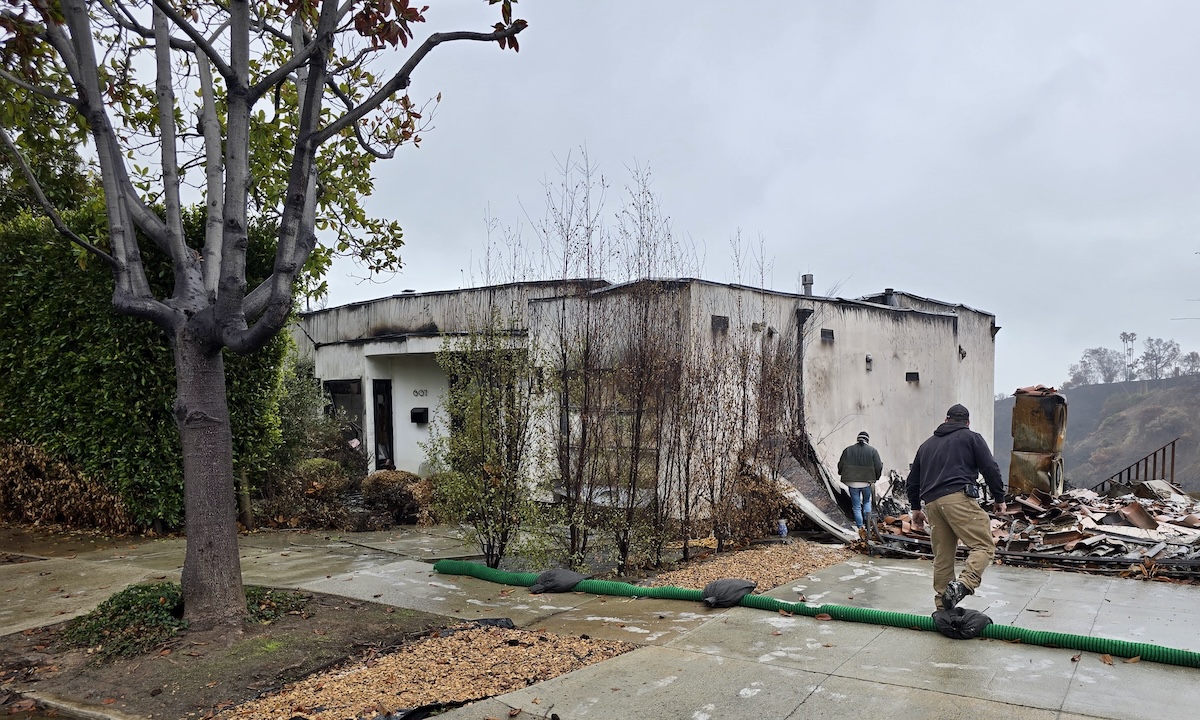
The cold-formed steel (CFS) floor framing, roof framing and wall framing of this home survived the Palisades Fire of January 2025.
Wood Building Blaze in Denver
On the evening of January 3, 2026, more than 100 firefighters battled a massive five-alarm in Denver at an apartment building construction site. One firefighter was injured and taken to the hospital.
“The building, which was in the early to mid-stages of construction, was primarily made of wood, with some plastic materials used in wrapping and construction,” said an ABC News article.
A Denver 7 video shows the devastation to a complete city block. NBC 9 News provided this video report:
Insurance Types: Builder’s Risk and Property
Builder’s risk insurance covers a building during construction. Once the building receives its certificate of occupancy, Arvola says, the coverage changes to permanent property insurance. The building will carry the latter policy year after year, during its entire hold period. The two insurance types tend to track together. When rates on one type are soft, the other is also soft. When rates rise on the one, the rates on the other also trend upward. And rates have risen sharply since 2020, Arvola says.
“We are in a very ‘hard’ property insurance market,” Arvola says.
- Wildfires and hurricanes: Losses on the West Coast and throughout the Southeast hit the entire insurance pool
- Construction fires: In November 2025, a wood-framed apartment complex under construction in Lehi, Utah, burned up quickly
The Midwest, too, has gotten hit. “The Midwest the past two years have actually had the most property losses,” Arvola says, citing tornadoes and lightning strikes impacting the rates for wood-framed builder’s risk insurance programs.
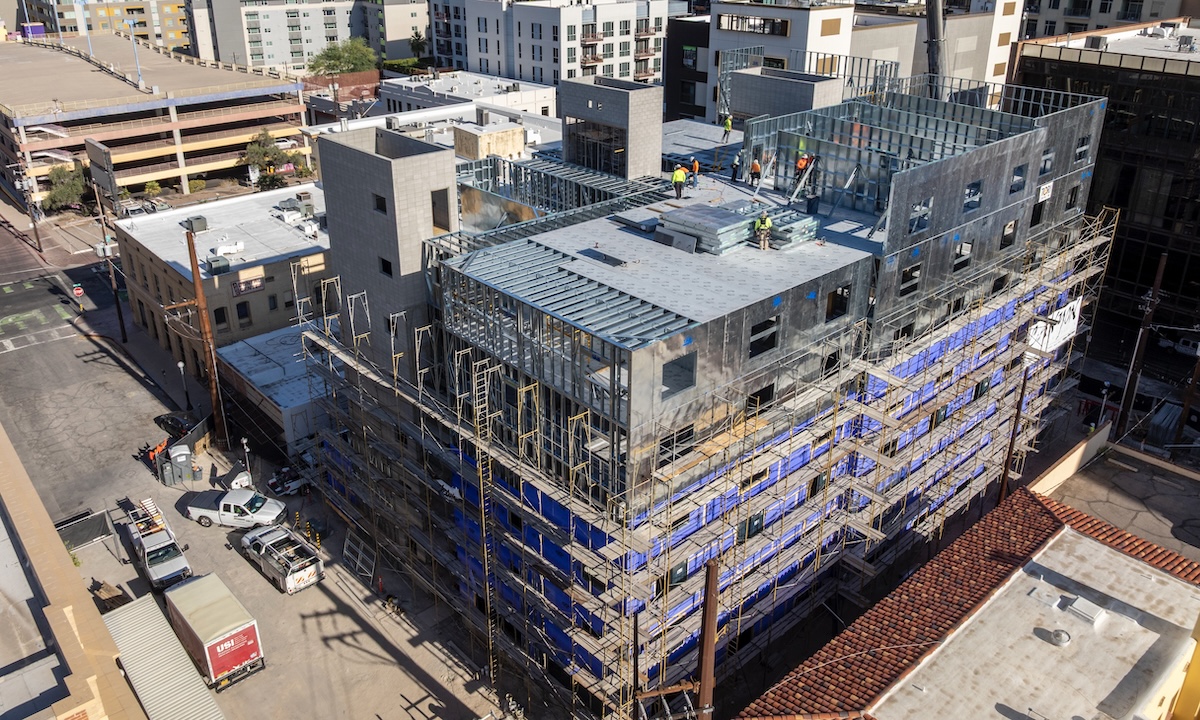
SFIA member Industrialized Construction Solutions used prefabricated cold-formed steel (CFS) framing to shorten exposure and lower the contractor’s liability insurance for the West Point Apartments II in Tucson, Arizona.
Insurance Advantages of Cold-Formed Steel
Risk comes down to one simple thing: the potential for catastrophic loss, Arvola says.
- Wood burns
- Steel doesn’t
Arvola tells a local story from his own area. A new wood-framed project — 90% complete — got hit by lightning. The entire building burned down to the ground. It’s the kind of loss that can completely change how underwriters view material risk — overnight.
“That’s just not going to happen with the steel product,” Arvola says.

Backed by Steel Framing Industry Association (SFIA), UC San Diego researchers tested a 10-story cold-formed steel (CFS) structure with 18 simulated earthquakes and a controlled burn. The building stood strong — a breakthrough for building taller and safer with steel framing.
Steel: Driving a Lifetime of Cost Savings
In fact, several catastrophic fire losses on wood-framed projects have appeared in the news, Arvola says.
One San Francisco wood-framed project lost roughly nine figures in value in a single event. Apparently, a transient individual entered a wood-framed project to sleep. He had a smoke and left the still-burning cigarette upon leaving the still.
When a wood-framed building burns down at 80% or 90% completion, the carrier eats the loss, Arvola says. They never recoup that dollar amount. Instead, the underwriters will adjust their assessment of risk.
“We would expect to see,” Arvola says, “insurance savings of more than 50% going from wood framing to a cold-formed steel product — every time.”
These are not soft deltas, Arvola says. They are hard underwriting spreads.
Surge in Fires: The Case for Steel Framing
Download this free article brief exploring the rise of fires in mid-rise wood construction across the U.S., highlighting incidents in California and Texas. The report outlines the key advantages of steel framing as a noncombustible alternative to significantly reduce fire hazards.

Can this Change Development Strategy?
Are developers changing their design strategies? Yes. And Arvola is now seeing those conversations begin.
“When one developer saw the pricing on his project come back, they were like, ‘Hey, we’ve got to look at our pipeline and see if we can do more of this type of work,’” says Arvola, speaking of steel-framed building designs.
It’s not just about construction period savings. The permanent coverage — the insurance carried for years — can remain lower as well.
“When they can take their insurance numbers and their proformas for not only the course of construction, but for their hold period, which for these guys could be 10 years, that 50% delta on the insurance number really changes the ROI,” Arvola says.
Look at the ROI
Is there a premium to build in steel? Perhaps. But Arvola says right now — because of insurance — developers are flipping the equation. They see an investment in steel framing delivering a faster payback — through a reduced insured risk premium.
Can the developer be in a better spot and have a better asset to sell in the future using cold-formed steel?” Arvola says. “Yes.”
That is new. Insurance is becoming a design variable, not a footnote, Arvola says.
“This is not a code argument, nor a brand argument. It’s not even an engineering argument,” Arvola says. “It’s an ROI argument.”
And because underwriters are now clearly pricing the combustion risk inherent in wood — and rewarding projects that avoid it — the insurance advantages of cold-formed steel are now a financial reality.