
The Charles Pankow Foundation announced the award of Research Grant Agreement #03-25 for an innovative project titled, “CURE – Code Updates for Reduction of Embodied-Carbon.” The grant supports Phase 1 of a national initiative to evaluate and revise U.S. structural engineering codes and standards with the goal of reducing embodied carbon in buildings.
As design loads are reconsidered and refined, cold-formed steel (CFS) framing stands to benefit from this research grant.
“This effort presents a unique opportunity to make meaningful reductions in material use across the board,” said Don Allen, executive director of the Steel Framing Industry Association (SFIA). “For cold-formed steel, that means the opportunity to build taller buildings with less materials, enhancing both the sustainability and structural efficiency of steel structures.”
Rethinking Codes, Reducing Carbon
This research represents a unique collaboration among leading structural engineering associations and research institutions. By reviewing long standing prescriptive code provisions through the lens of embodied carbon, the research team will identify high-impact opportunities for immediate improvement, starting with requirements that directly influence material quantities used in construction.
A 10-member committee of practicing engineers and researchers will lead the one-year Phase 1 study, producing a prioritized list of code provisions to target for revision. The goal is to identify modifications that reduce carbon emissions while preserving life safety and structural reliability.
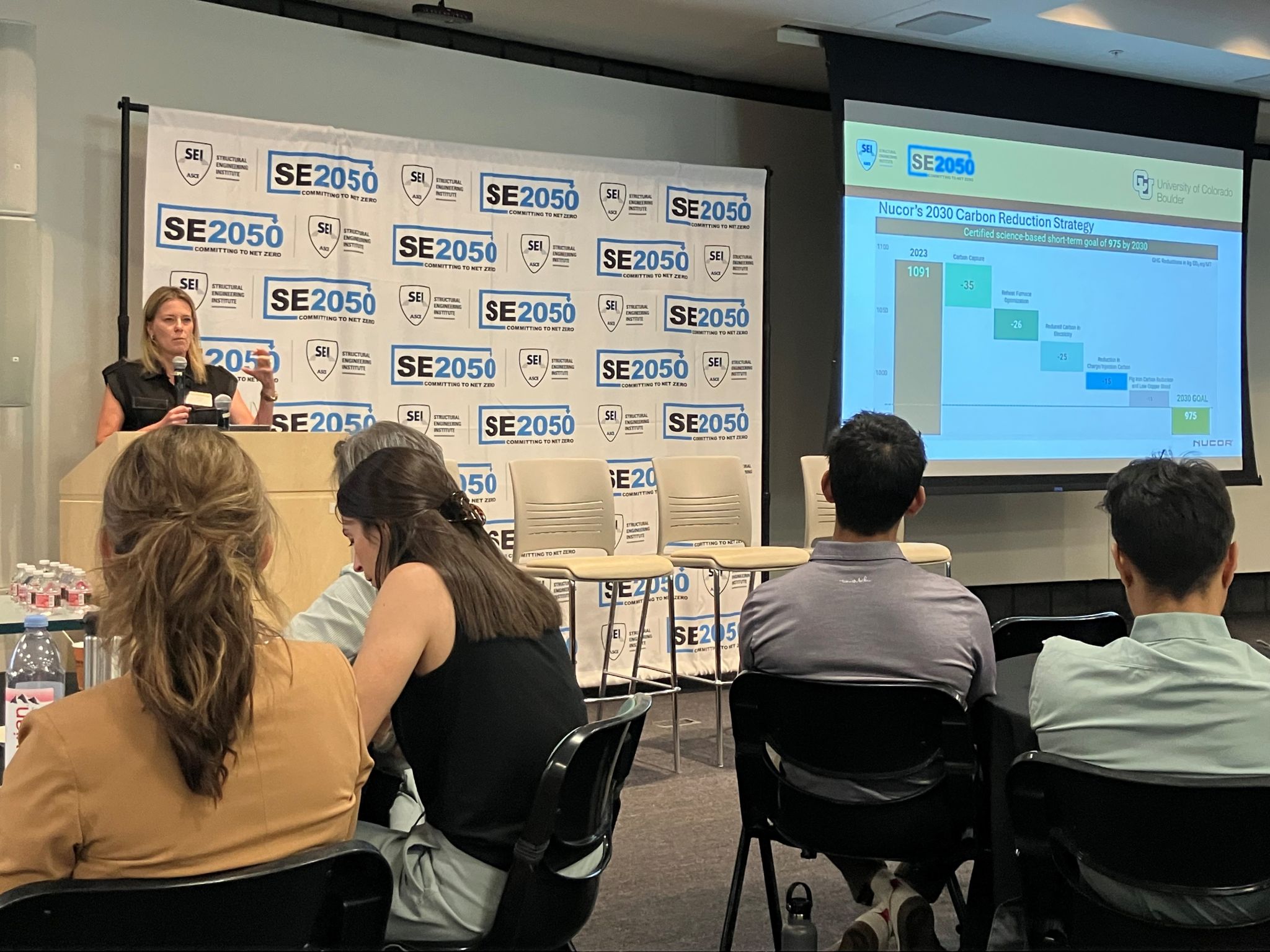
Kim Olson of Nucor presented the company’s 2030 carbon reduction strategy at the Toward Zero Carbon 2025: Summit & Symposium, held June 26–27 at the University of Colorado Boulder.
Phase 1 Kicked Off at Zero Carbon Summit
The initiative was officially announced during the Toward Zero Carbon 2025: Summit & Symposium, held June 26–27 at the University of Colorado Boulder. The project brings together a team of engineers and academics to examine how updates to current code provisions — including ASCE 7, ACI 318 and the AISC Specification — can lead to more sustainable material use without compromising structural integrity.
The $200,000 grant for Phase 1 is funded by CPF in partnership with the MKA Foundation, American Society of Civil Engineers, American Institute of Steel Construction, National Council of Structural Engineers Associations, American Concrete Institute and the University of Colorado Boulder.
At the conclusion of Phase 1, the group plans to launch Phase 2, which will involve targeted research to support proposed code revisions. The long-term vision includes international collaboration to apply similar updates worldwide.
Driving Systemic Change
By reframing structural design codes with sustainability in mind, this initiative sets a new precedent for how the engineering community can address climate challenges. In doing so, it opens the door to safer, smarter and more efficient structures.
For CFS, the opportunity to optimize designs for reduced loads could extend its application in taller buildings, reinforcing steel’s position as a resilient and sustainable framing solution.
Additional Resources
- SFIA’s Don Allen Shares Insights on Technology, Training and Code Advocacy on “If Walls Could Talk”
- How High Can You Construct a Building with Cold-Formed Steel Framing? The Answer May Surprise You
- SFIA Launches a Repository for Its Publications: A Hub for Steel Framing Technical Resources