
Featured image: Pat Hainault of the CFSEI Executive Committee and SFIA member raSmith opens the 2025 CFSEI session “State of the Standards,” joined by Jay Larson (SFIA), Tom Sputo (SDI), Christopher Raebel (AISC), Pat Ford (SFIA) and JP Cardin (MBMA).
RALEIGH, N.C. — The opening session of the 2025 CFSEI Expo, May 19–21, presented by Cold-Formed Steel Engineers Institute (CFSEI), set the tone for a pivotal year in cold-formed steel (CFS) framing.
In “State of the Standards,” a panel of five technical leaders gave attendees a clear view of how CFS standards are being managed following the American Iron and Steel Institute’s exit from standards development in late 2023.
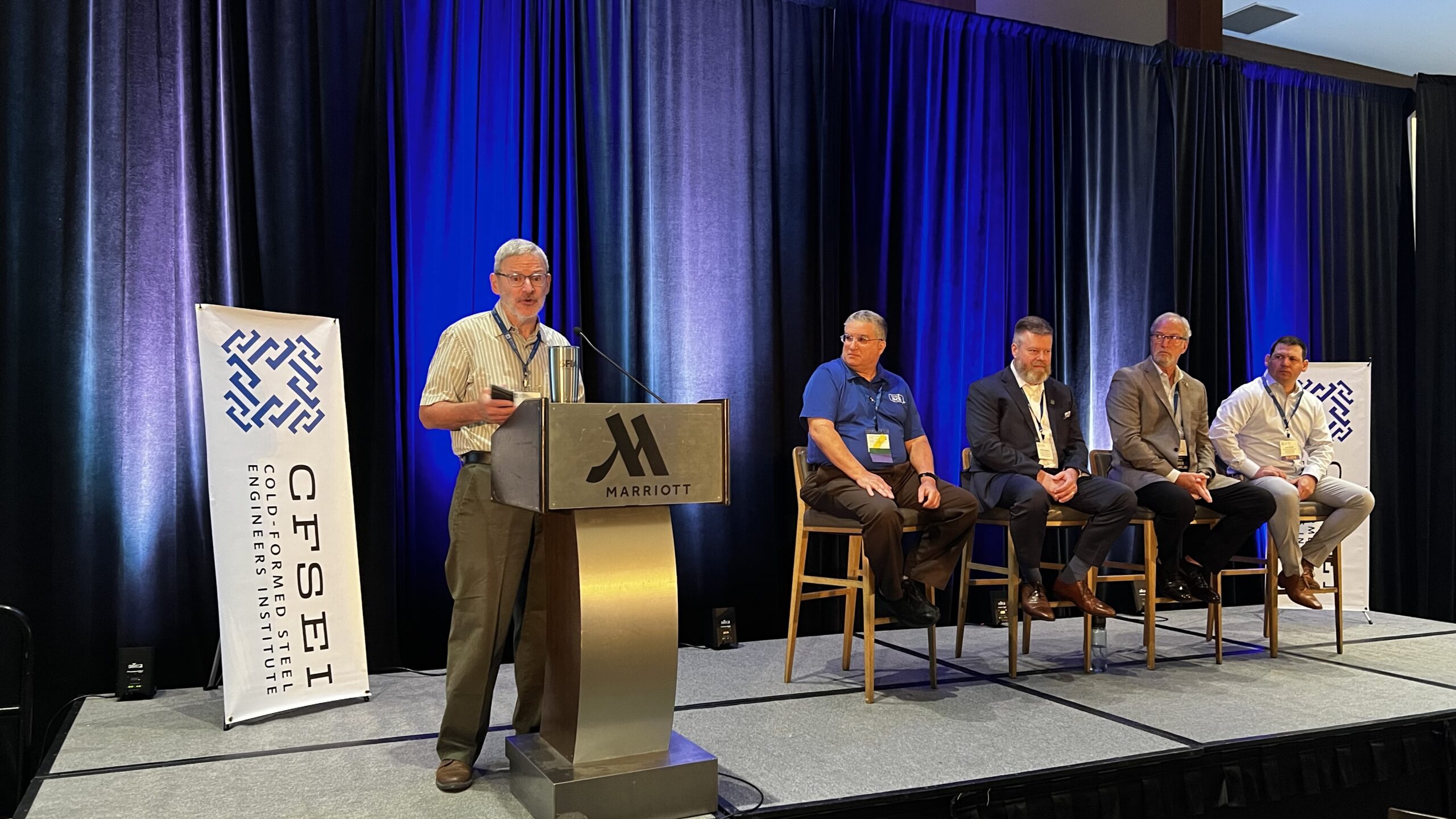
Jay Larson moderates the 2025 CFSEI “State of the Standards” session with panelists Tom Sputo, Chris Raebel, Pat Ford and JP Cardin.
Collaborative Transition, Stable Future
Jay Larson: The Industry Acted Quickly
Jay Larson, P.E., F.ASCE, former AISI managing director and now secretariat for the Steel Framing Industry Association (SFIA) Standards Committee, moderated the panel. He began by outlining the significance of ANSI-accredited standards in shaping building codes and preserving the credibility of CFS design nationwide.
“For over 75 years, AISI was the steward of cold-formed steel standards,” said Larson. “But when AISI stepped back from funding code and standards work in October 2023, the industry had to act quickly to preserve the integrity and legal standing of those standards.”
That urgency led to the transfer of AISI’s 33 standards to the Steel Deck Institute by the end of 2023. Since then, efforts have continued to distribute responsibility for maintaining and updating these standards to organizations better aligned with each standard’s focus — such as, the SFIA’s management of the steel framing standards.
Tom Sputo: Safeguarding the “Mothership”
Tom Sputo, P.E., technical director of SDI, recounted how his early hunch in mid-2023 prompted the SDI to prepare for the transition. “Some call me psychotic, but really — I’m psychic,” he joked. That intuition helped SDI act swiftly when the formal announcement came.
SDI retained seven of the original AISI standards, including three it will permanently maintain: S310 (diaphragm design), S907 (diaphragm testing) and S922 (interference connector testing). Most critically, SDI is the temporary steward of S100 — the foundational CFS design specification often referred to as “the mothership.”
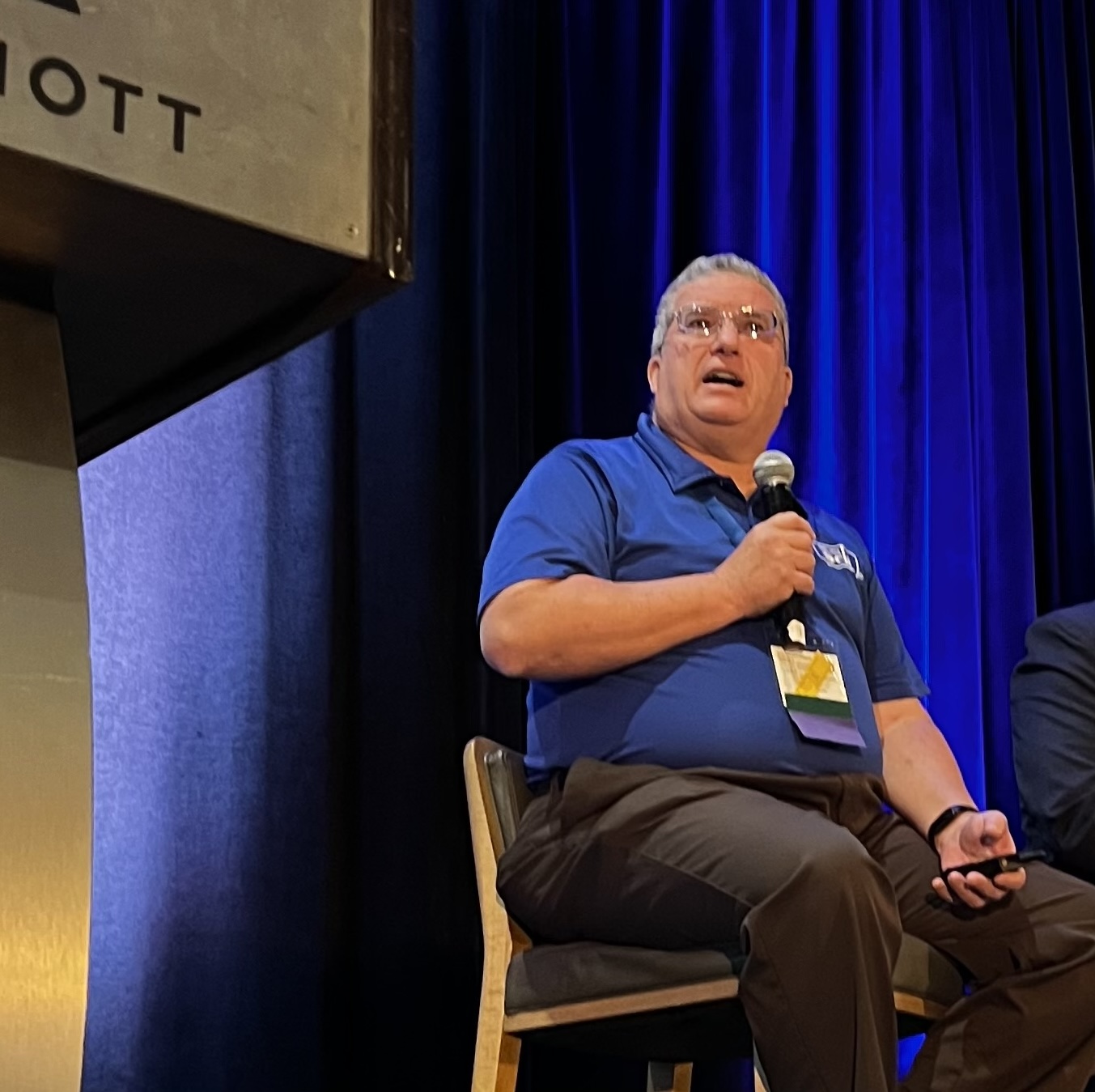
Tom Sputo of SDI shares the Steel Deck Institute’s perspective on the future of cold-formed steel (CFS) standards at the 2025 CFSEI Expo.
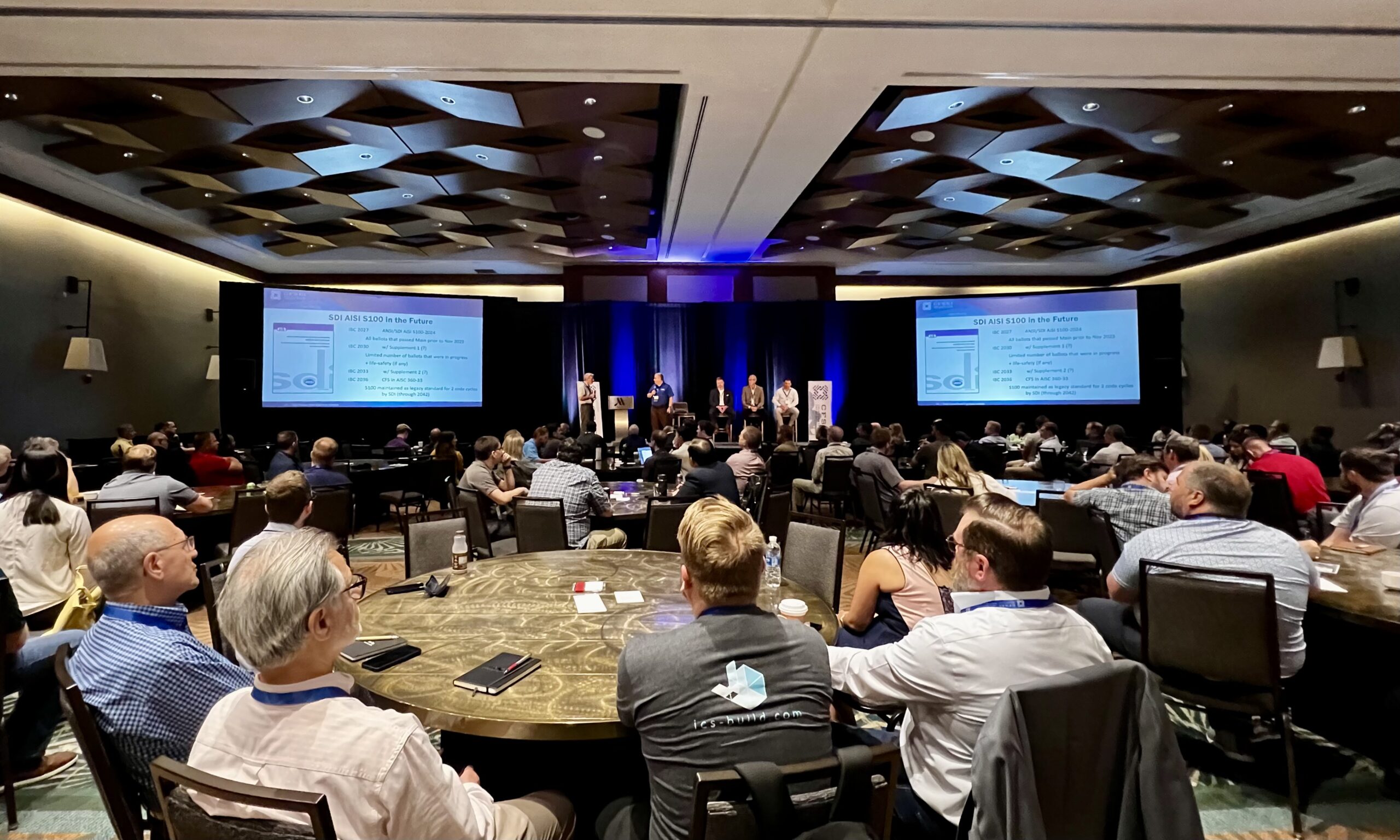
Attendees listen as Tom Sputo of SDI presents during the “State of the Standards” session at the 2025 CFSEI Expo.
Sputo emphasized that the 2024 edition of S100 has been secured and is scheduled to be referenced in the 2027 International Building Code. “That’s all good,” he said. “We may issue a small supplement before the 2030 codes to account for a few remaining ballot items, but we’re focused on long-term continuity.”
Sputo also clarified that SDI develops standards using a “canvas process,” which engages a balanced, ad hoc group of reviewers. That will continue as SDI collaborates with other groups — potentially including the American Institute of Steel Construction — as standards evolve.
Christopher Raebel: Integrating CFS into AISC 360
AISC’s Vice President of Engineering and Research, Christopher Raebel, P.E., described his organization’s long-term plan to incorporate CFS provisions into AISC 360, the specification for structural steel buildings.
That integration, slated for 2033, will potentially unify structural and cold-formed steel design under one roof.
“It’s a continuum from thin to thick,” said Raebel, echoing Sputo’s earlier comment. “This is an opportunity to bring cold-formed steel into the mainstream.”

During the 2025 CFSEI Expo, Christopher Raebel of the American Institute of Steel Construction discusses plans to integrate cold-formed steel provisions into the AISC 360 standard.

A slide Raebel shared shows the members of the AISC Cold-Formed Steel Advisory Group working to align CFS provisions with AISC 360.
AISC has already hired a consultant and formed a task group — including engineers experienced in both hot-rolled and cold-formed steel — to assess how S100 and AISC 360 align. That group will expand into a dedicated cold-formed steel task committee, ensuring that CFS-specific input informs every relevant section of the AISC spec.
Raebel acknowledged the competitive tension between structural steel and cold-formed steel but insisted collaboration outweighs rivalry.
“Where we compete, we’ll compete. Where we can cooperate, we will,” he said.
Patrick Ford: Looking for Broad Participation
Representing SFIA, technical director Patrick Ford, P.E., brought humor — a cautionary tale about his 96-year-old mother’s Silver Maple — to his discussion of SFIA’s role in standards management.
The SFIA, Ford said, has assumed responsibility for 18 AISI standards, primarily those related to framing. The association established a standards committee — SFIA Standards Committee — in mid-2024, achieved ANSI accreditation, and began work immediately, holding nine meetings since July.
“We’ve already started balloting updates to S202 and S220,” Ford said. “We’re using the canvas method too, and we’re not just pulling from SFIA members — participation is open.”
Ford detailed several proposed changes, including adding slipped head-of-wall conditions to the S916 (composite wall test standard), and a new test standard tentatively titled S925. He also flagged potential corrections to legacy standards, such as tighter punch-out spacing in S220 and updated coating inclusions in S240.
“The ICC has told us these updates can be administrative, which means they can still be included in the 2027 code,” Ford said. “Our deadline is December 2026.”
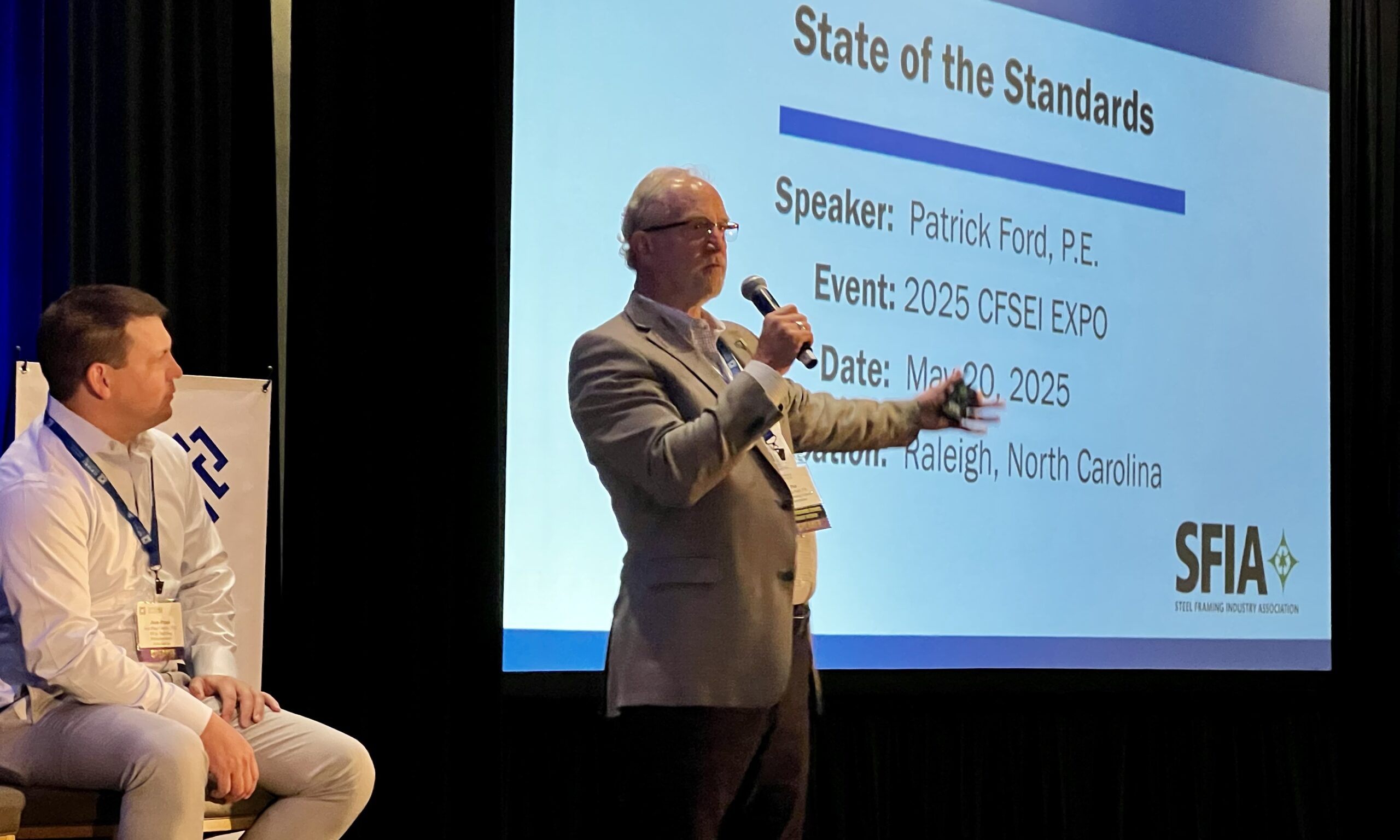
SFIA’s Technical Director Pat Ford speaks during the “State of the Standards” session as MBMA’s JP Cardin looks on.
JP Cardin: Filling the Gaps
JP (Jon-Paul) Cardin, P.E., assistant director of research and engineering at the Metal Building Manufacturers Association, brought a unique perspective. Before joining MBMA, Cardin helped lead standards development at AISI, giving him insider insight into the full transition.
MBMA became an ANSI-accredited Standards Development Organization in early 2025. As such, a handful of AISI test standards relevant to metal building systems have been transferred to MBMA, which stands ready to develop new standards as needed.
“For example, AISI S100 Section I6 on metal roof and wall panel systems might evolve into its own standard,” Cardin said. He also pointed to a lack of regulation around commonly used components like hillside washers. “These are opportunities to develop standards that benefit our specific industry.”
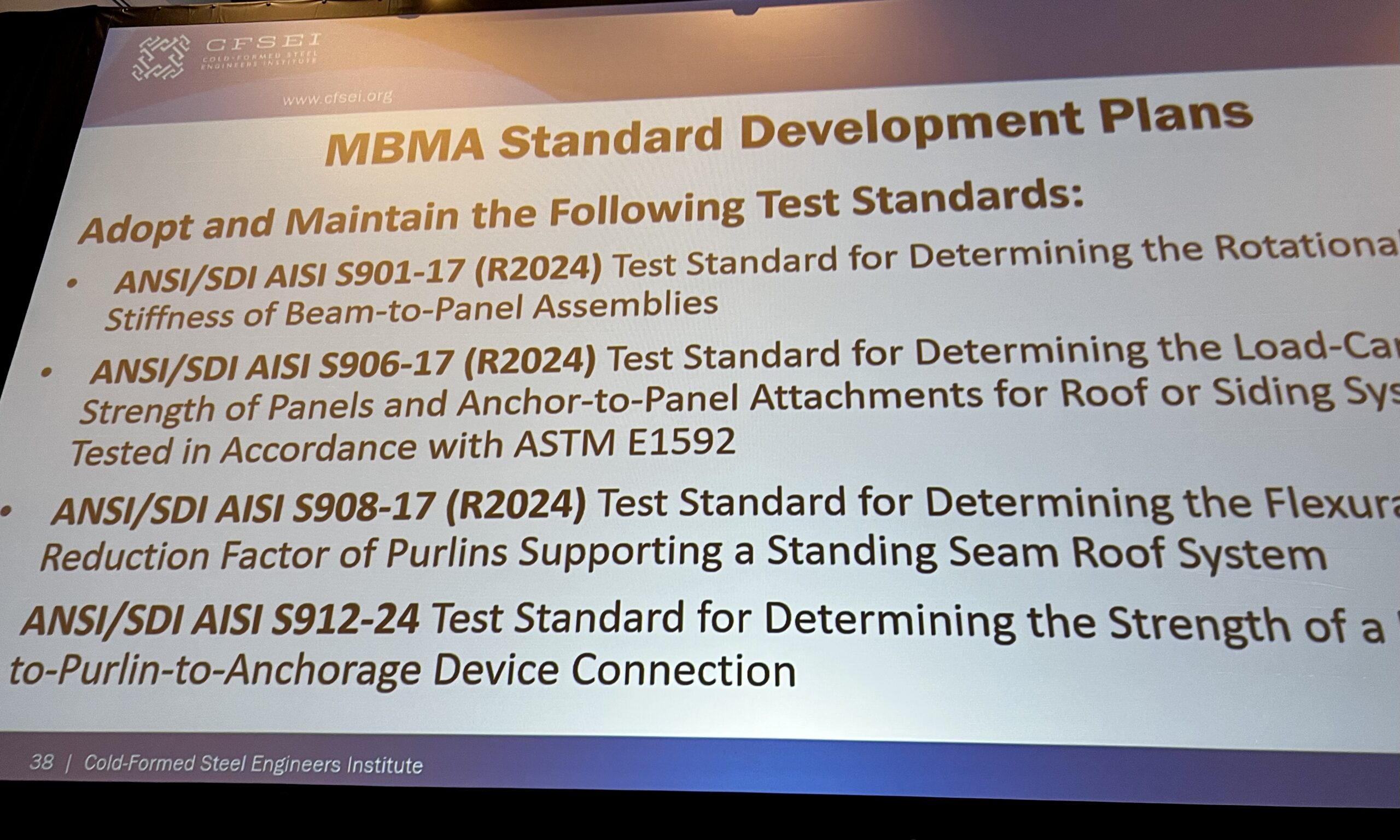
During his presentation, JP Cardin outlined MBMA’s plans for developing and maintaining cold-formed steel (CFS) standards relevant to the metal building industry.
Though MBMA’s scope is narrow, Cardin emphasized its commitment to preventing any vital test standards from falling through the cracks.
Stay Engaged, Stay Informed
Moderator Larson concluded the session by reinforcing the value of the ANSI standards process — especially transparency, public input and consensus.
“Cold-formed steel standards have found new homes,” he said. “But they’ll only stay strong if we stay engaged.”
He encouraged designers and engineers to participate in canvas groups, ballot reviews and task forces. “Your questions, your feedback — those are how we ensure cold-formed steel remains a respected and code-recognized building material,” Larson said.
As for the remaining “orphaned” standards — eight in total, including S100 — Larson and the panelists expressed confidence that ongoing collaboration will resolve their long-term governance.
As cold-formed steel advances into broader structural applications, and as standards align under new leadership, one thing is clear from the session: the future of steel framing standards is both secure and evolving. With SDI, AISC, SFIA and MBMA each taking responsibility — and inviting participation — the groundwork has been laid for the next generation of design codes to reflect the innovation and reliability that CFS framing has always delivered.
Cold-Formed Steel Engineers Institute
The Cold-Formed Steel Engineers Institute (CFSEI) comprises hundreds of structural engineers and other design professionals who are finding a better way to produce safe and efficient designs for commercial and residential structures with cold-formed steel. CFSEI members work together to develop and evolve industry standards and design methods, produce and issue technical bulletins and provide seminars and online training to improve the knowledge and skills base of engineers and design professionals. For more information, visit www.cfsei.org.

Additional Resources
- Insights and Inspiration Take Center Stage at 2025 CFSEI Expo in Raleigh
- SFIA Appoints Jay Larson as Secretariat of the Newly Formed SFIA Standards Committee
- With ANSI Accreditation, SFIA Begins Process of Managing CFS Framing Standards