
Featured image: New residences off Wynkoop Street in Denver’s River North Arts District feature cold-formed steel (CFS) framing. Images courtesy of CEMCO.
The new residences off of Wynkoop Street, located in Denver’s River North Arts District, are part of a 16-story, mixed-use high-rise that boasts private balconies, some with mountain and city views. The structure features post-tension deck construction and a prefabricated, cold-formed steel (CFS) framed panelized exterior.
The multi-family residential structure provides convenient access to RiNo restaurants, bars and entertainment centers. Popular destinations nearby include Improper City, Blue Moon Brewery, Globeville Landing Park, Dover Central Market and over 200 art galleries and boutiques.
CEMCO, one of the largest manufacturers of steel framing systems in the United States and a member of the Steel Framing Industry Association (SFIA), supplied the CFS studs and track for the Wynkoop Street project.

CEMCO, a member of the Steel Framing Industry Association (SFIA), supplied the cold-formed steel (CFS) framing systems for the Wynkoop Street project.
CEMCO is the SFIA 2024 Industry Project Awards winner for the multi-family project off Wynkoop Street in Denver, winning in the Efficient Use of Cold-Formed Steel Framing category. The SFIA Awards entry was submitted by Stephen Bradford of Select Prefab Co.
CEMCO’s win was announced at the 2024 SFIA Awards ceremony held live recently and posted online. The SFIA 2024 Industry Project Awards, an annual awards competition, focuses on CFS manufacturing and construction. This year, designers, manufacturers, distributors and contractors entered a variety of projects in the competition.
Design Quality
Did this project make efficient use of metal framing products?
The Wynkoop Street project was originally designed by a different architecture firm. A different GC was also originally contracted to build it. The owners, however, sought out better value through the prefabrication of the exterior envelope. Select Prefab prefabricated this exterior system, which was designed by Salas O’Brien, a member of the Cold-Formed Steel Engineers Institute (CFSEI).
The prefabricated panels provided the best value to the owners by stressing cost savings. The transportation and storage of the panels employed Select Prefab’s custom manufactured trailer, which allowed the panels to be palletized and shipped upright for easy and immediate installation upon delivery to the site.

Salas O’Brien, a member of the Cold-Formed Steel Engineers Institute (CFSEI), designed the exterior panel framing system.

The prefabrication of the exterior envelope panels and their installation was handled by Select Prefab Co.
Wide Single-Story Panels Used
The specialty engineer spoke about the panelization at the Wynkoop Street project: “We employed panelization and lifting layout that allowed lighter stud weight and less steel and no welding. Using wider single-story panels, instead of 2-story tall, 10-foot to 12-foot-wide panels, allowed for maximum stud weight economy, using 43mil thickness for most wall framing.”
“Tilting loads for two-story panels often create a requirement for heavier standard stud framing regardless of wind loading demands,” the engineer added. “CFS lifting clips were utilized removing welded steel angles and bolts. Using a mid-slab joint removed requirements for a welded steel plate and pin connection, further economizing material and installation costs.”
The 2024 SFIA Awards judges noted that the “project demonstrated maximizing strength” in the use of CFS, while also “cutting down thickness” of the steel studs. The judges also noted that the steel framing design was a “good example that can be applied to future projects.”

Using wide, single-story panels — with 43 mil cold-formed steel (CFS) stud thickness — allowed for maximum stud weight economy.

The 2024 SFIA Awards judges said the Wynkoop Street project “demonstrated maximizing strength” in the use of cold-formed steel (CFS).
Installation Complexity
What difficulties existed on the project?
This Wynkoop Street project used a significant amount of connection details for the post-tensioned concrete structure. These details included cast-in-place materials — placed in the concrete when the slabs were poured.
This technique, developed by Select Prefab, allowed for all connections to be ready to install at the slabs when the panels were lifted into place. The connection materials allowed greater efficiency when installing the panels, and they cut down on the time required for installation.
“Sharing crane time with critical path subcontractors such as the concrete framers is always difficult, but the schedule savings proved to be a valuable commodity,” the awards submission narrative said. “Time is money.”
As the concrete framing was being performed, the CFS-framed panels were being installed simultaneously three to four floors below. The shoring allowed the slabs to cure.

Select Prefab’s panels, shown here being readied for delivery, proved to be a valuable commodity for schedule savings at the Wynkoop Street project.

Panelization produced an exterior system with less weight, less cold-formed steel (CFS) and no welding, the specialty engineer for the Wynkoop Street project said.
Condensed Workflow Due to Prefabrication
Meanwhile, the interior metal framing, drywall and finishes followed behind also by three to four floors. This allowed for a condensed workflow to proceed while the rest of the building’s structure was being completed. In other words, the exterior panel prefabrication generated a huge cost savings to the owner, “who could see his building on the lower floors almost complete as the structure was getting topped out,” the awards submission narrative said.
Since Select Prefab’s panels have all the finish fascia installed at the fabrication facility, the final requirement for dry-in was caulking the panel joints.
Complex Roof and Parapet Attachments
This panel project employed different engineering and complex attachments at the roof and parapet areas, as a Salas O’Brien engineer noted:
“Most design challenges occurred at the roof parapet and reentrant courtyard corners,” the engineer said. “The roof has concrete planter walls along some perimeter locations, which created access issues for installation.”
“For these conditions, we created a pin connection designed to allow installation with limited access from under the roof slab,” the engineer added. “At the reentrant corners where panels had no support over windows, we engineered the panels with a top beam to carry the panel weight above windows where there could not be standard jamb or clip connection framing at the corner.”

“We engineered the panels with a top beam to carry the panel weight above windows,” the specialty engineer for the Wynkoop Street project said.

The cold-formed steel (CFS) studs and track were ordered in custom lengths from CEMCO to avoid waste and increase efficiency in the panel fabrication shop.
Manufacturing Complexity
Were special materials involved?
This project was panelized by design using non-standard size, single-story panels up to 36 feet wide.
Most of the design challenges occurred at the roof parapet and reentrant courtyard corners. An enormous amount of enclosure per panel materials were engineered to resist described loads and still be an efficient use of steel. All steel studs and track were ordered in custom lengths from CEMCO to avoid waste and increase efficiency in the fabrication shop.
“The process for ordering these custom metal pieces was seamless,” the awards submission said.

The Wynkoop Street project was panelized by design using non-standard size, single-story panels up to 36 feet.

The cold-formed steel (CFS) framing of the panels helped to compress the overall project schedule.
Overall Job Quality
How did the completed system turn out?
The project quality is best described as “Best in Market,” the awards submission said.
By focusing on the pre-construction components of the project with the design team, this project became a great example of prefabrication and mixing materials for a truly modern multi-family building.
“It is the best-looking building in the area as it rises above its neighbors in sharp contrast to the drab buildings that are adjacent to it,” the awards submission said. “Several product reps have shared their thoughts on the exceptional level of quality inherent in the design and finishes. The owners are quite pleased as well with the look of the project.”
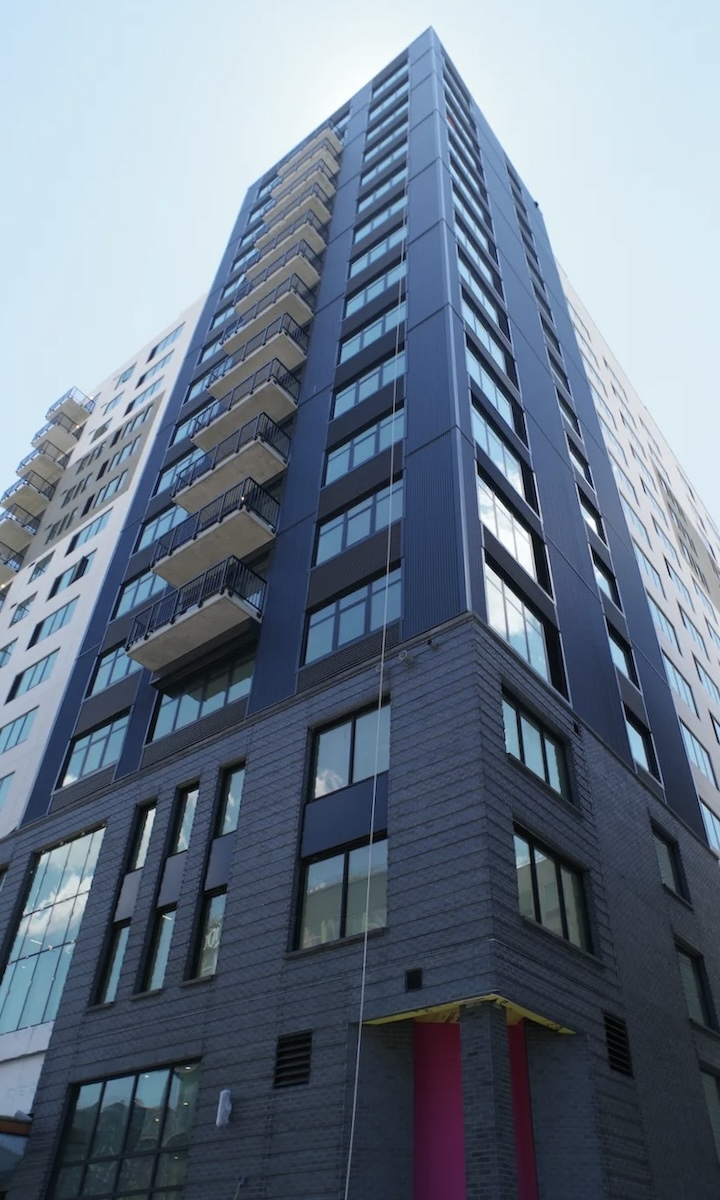
“It is the best-looking building in the area,” the SFIA awards submission said.
Conversion to Steel
How was conversion to metal framing achieved?
The CFS design of this project through value engineering allowed for the steel stud sizes to be reduced, while achieving greater unit sizes of each of the panels. Cost savings was achieved through less weight, less expense in costs per square foot and a shorter install duration over the construction time of the overall schedule.
CEMCO is the 2024 SFIA Awards winner in the Efficient Use of Cold-Formed Steel Framing category of CFS for the Wynkoop Street project. The project also involved supplier and SFIA member The Steel Network and the engineering firm of Salas O’Brien, an and CFSEI member.
Wynkoop Street
RiNo Art District
Denver, CODetails: 130,000 square feet, 182 units, 88 tons of cold-formed steel used on the project
PEOPLE
Owner
RiNo PartnersArchitect
Studio 646 ArchitectureEngineering Firm
Enayat Schneider SmithGeneral Contractor
I-KotaCFS Manufacturer
CEMCOOther Providers
The Steel Network (TSN)
Salas O’Brien

SFIA Industry Project Awards
The SFIA 2024 Industry Project Awards focus on cold-formed steel (CFS) manufacturing and construction. A panel of industry representatives judged all 2024 SFIA Awards entries based on the following criteria:
- Design Quality, such as the efficient and sustainable use of CFS products
- Installation Complexity, focusing on conflict resolution, timeframe challenges, etc.
- Manufacturing Complexity, including custom orders, panelization, special material sourcing and more
- Overall Job Quality, including the quality of alignments, finishes and other attention to detail
- Conversion from Alternative Framing Material, reflecting how steel framing lowered a structure’s weight, or added stories, or helped lower the project’s builders’ risk insurance, etc.
About SFIA
The Steel Framing Industry Association (SFIA), a unique organization representing steel mills, coil coaters, stud and connector manufacturers, component fabricators, Cold-Formed Steel Engineers Institute (CFSEI) members, suppliers/distributors, contractors and others, provides members with exclusive access to technical cold-formed steel (CFS) framing services, including CFS certification, environmental product declarations, market data and analysis, technical design guides, specification review services, architectural services, the Steel Framing Learning Portal , the SFIA Awards and more. SFIA is an accredited ANSI Standards Development Organization. Follow SFIA on LinkedIn, Facebook, Instagram and X.

Additional Resources
- SFIA Unveils 9 Winners of the 2024 Industry Project Awards
- SFIA Reveals 7 Winners of the 2023 Industry Project Awards in Online Ceremony
- Designers: Update to SFIA’s 2024 Tech Guide for the Latest CFS Load and Span Tables