
Several recent studies conclude that cold-formed steel (CFS) sheet sheathing is durable and performs well in seismic situations.
The researchers involved in these studies say that CFS sheet sheathing is a novel approach to design. CFS sheathing, unlike plywood panels and oriented strand board (OSB), is strong, ductile and noncombustible, they say. They note additional benefits of CFS in their papers.
Seismic Deflection of CFS Shear Walls
Mohammed M. Eladly, M.S., and Benjamin W. Schafer of Johns Hopkins University Baltimore, Maryland, presented their findings at the Cold-Formed Steel Research Consortium (CFSRC) Colloquium, October 17-19, 2022, in the proceedings entitled, “Assessment of AISI-S400 deflection equation for cold-formed steel framed shear walls.”

The expression for shear wall seismic design as determined by AISI S400-20.
They also drafted the same study in a paper, which is out for peer review, pending publication in the Journal of Structural Engineering. The later manuscript is entitled, “Evaluation of seismic deflection amplification factor for buildings utilizing cold-formed steel framed shear walls.”
Eladly and Schafer evaluated the deflection amplification factor for buildings using CFS framed shear walls. Their work was comprehensive and involved “an extensive numerical parametric analysis of the deflection amplification factor for a series of archetype buildings utilizing cold-formed steel framed shear walls,” says an abstract to their paper obtained by BuildSteel. A CFSRC article says their research paper is under final revision with a journal.
The researchers studied 118 different archetype buildings using software models to analyze how the buildings would perform when subject to earthquakes.
- 83 buildings had CFS framed shear walls with steel sheet sheathing
- 35 buildings employed wood structural panel sheathing
Eladly and Schafer investigated a total of 5,192 cases in the study, comparing the results to the AISI S400 deflection expression recommended in current practice.
“The results show that current practice may overestimate expected deflections,” say the authors. They recommend “a linearization of the AISI S400 deflection expression” to simplify design.
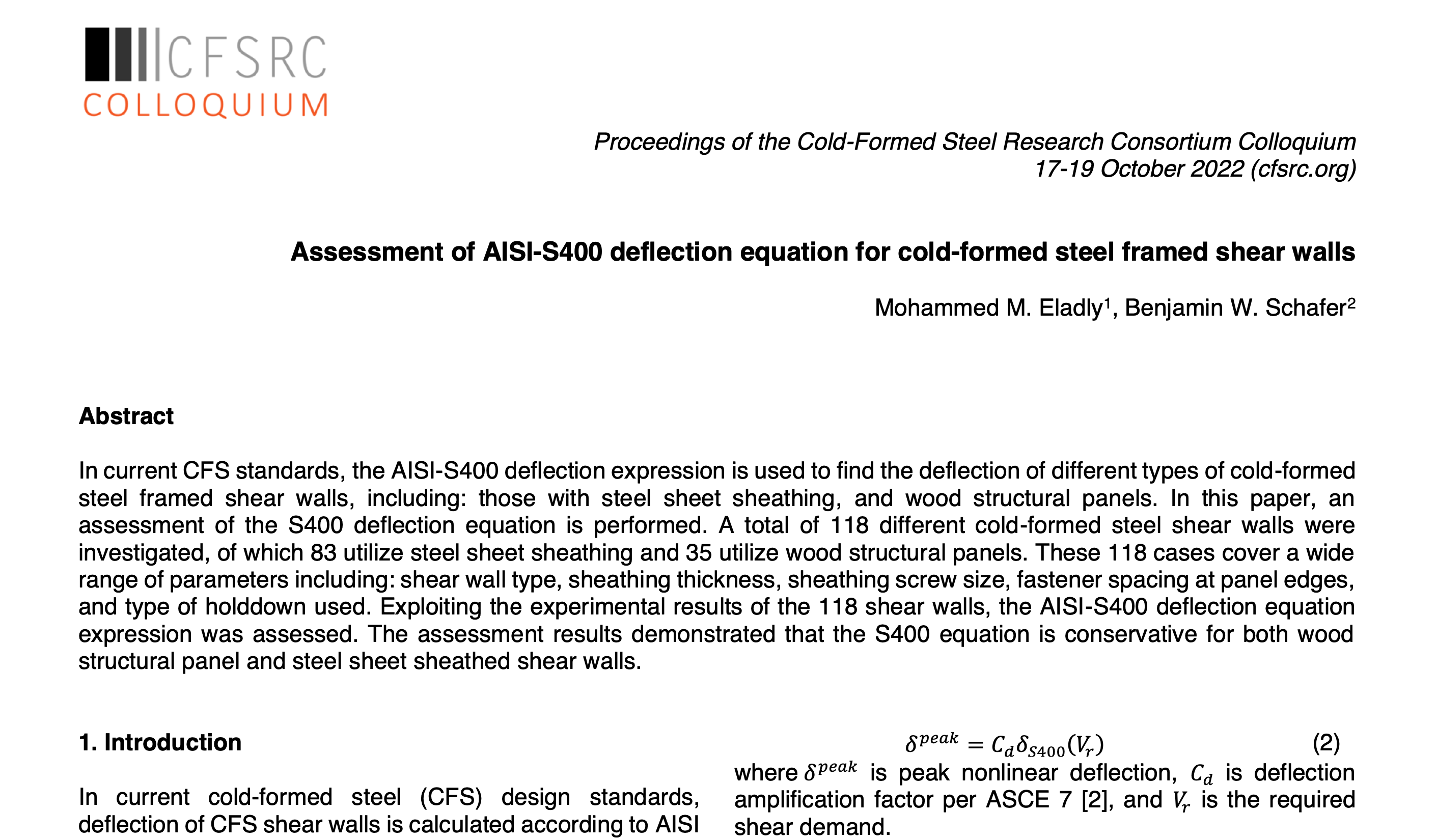
Cold-Formed Steel Research Consortium Colloquium 2022 proceedings included this presentation by Mohammed Eladly of Johns Hopkins University.
Steel Sheathing: Strong and Noncombustible
Another research paper focuses on using CFS sheets as sheathing, something the paper’s authors say is relatively new.
Researchers Amanpreet Singh, Xiang Wang, Zhidong Zhang, Fani Derveni, Hernan Castaneda, Kara D. Peterman, Benjamin W. Schafer and Tara C. Hutchinson conducted experiments to document the performance of steel sheet sheathed CFS-framed wall assemblies. They published their results in the Journal of Structural Engineering in the paper entitled, “Steel Sheet Sheathed Cold-Formed Steel Framed In-line Wall Systems. I: Impact of Structural Detailing.”
“The understanding of CFS wall-line structural behavior, particularly the contribution from non-designated systems such as gravity walls, under seismic events remains limited,” says the paper’s abstract, as reported on the website of the American Society of Civil Engineers.
“In seismic zones, CFS-framed buildings utilize shear walls to provide the primary lateral resistance to earthquake induced loads,” the abstract continues. “Although oriented strand board (OSB) and plywood panels have been traditionally used as the sheathing material for these essential components, more recently, steel sheet sheathing has emerged as a novel strategy due to its strength, ductility, ease of installation, and use of noncombustible material, among other benefits.”
The researchers employed a two-phased program. In Phase I, pairs of eight shear walls were tested on the Natural Hazards Engineering Research Infrastructure (NHERI) large high-performance outdoor shake table at the University of California, San Diego, Structural Engineering Powell Laboratory. They used 10 single wall-line configurations for Phase II of the study.
The paper, which is available for download for a fee from the ASCE, quantifies “the impact of test variables governing the structural detailing of CFS-framed walls,” says the abstract. It adds that a companion paper presenting the impact of architectural variations on seismic performance is also available.
Additional Resources
- AISI Announces Winner of 2022 Market Development Industry Leadership Award
- 3 Projects Where Steel Framing Solved Architectural Challenges
- Steel—Doing It Right®: Metal Framing Has Many Advantages and is Green